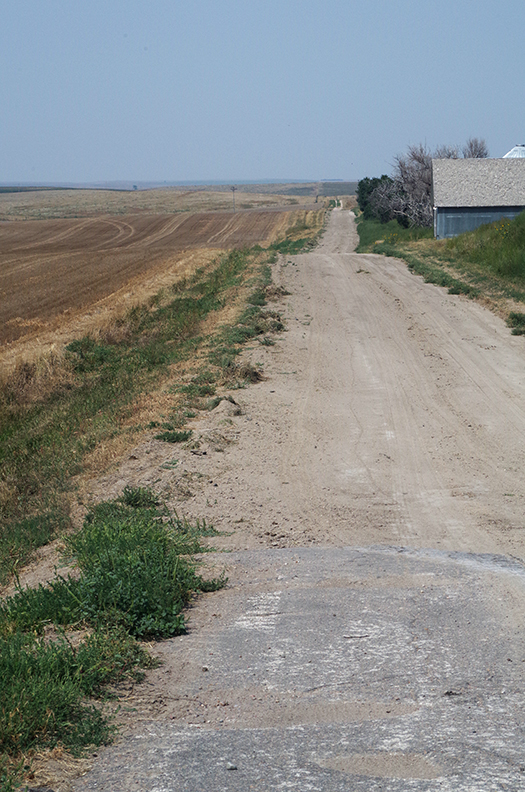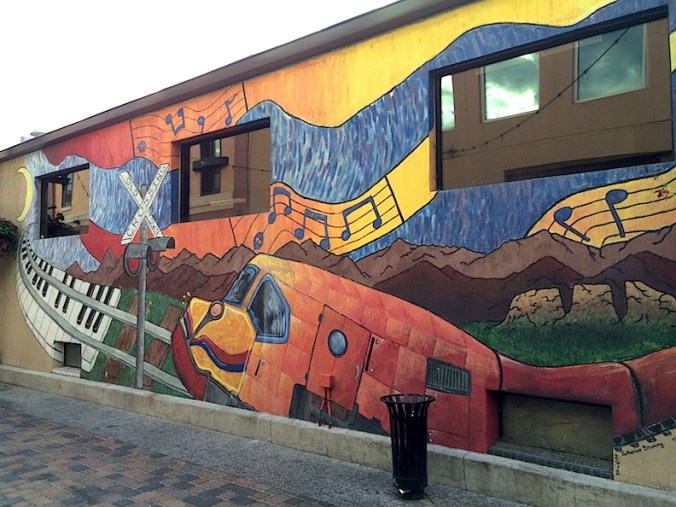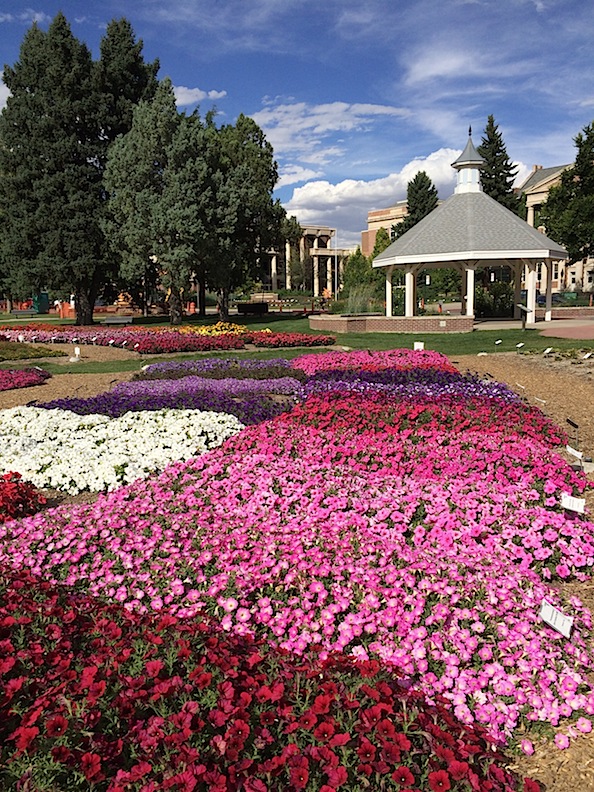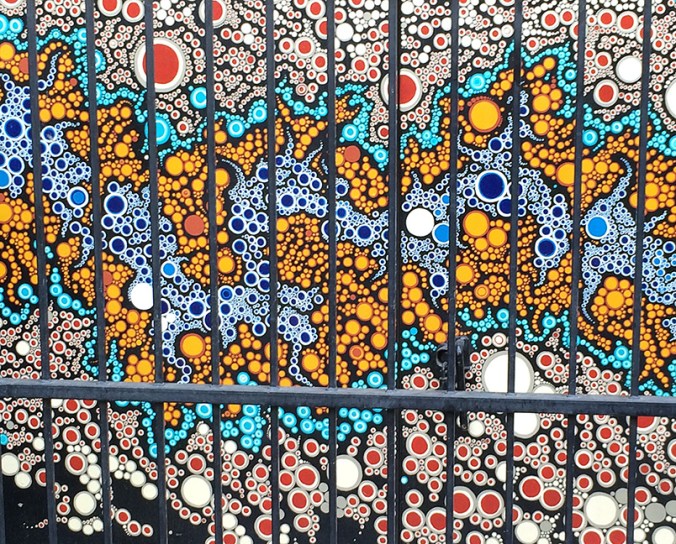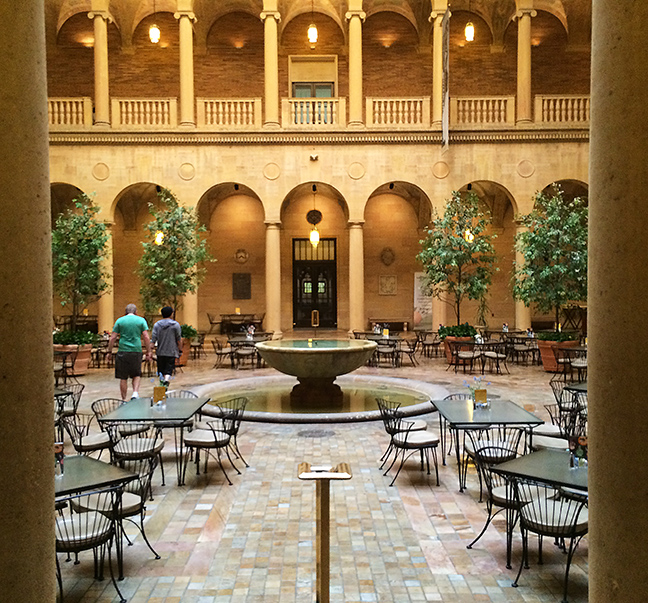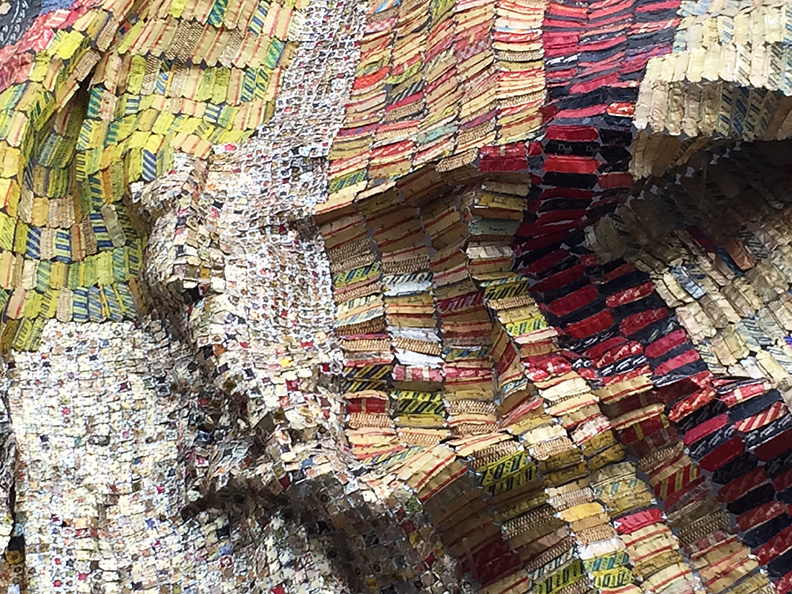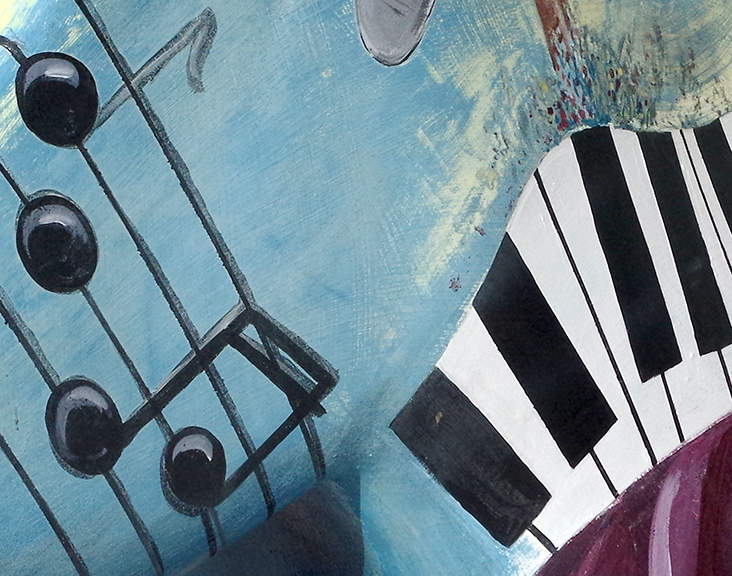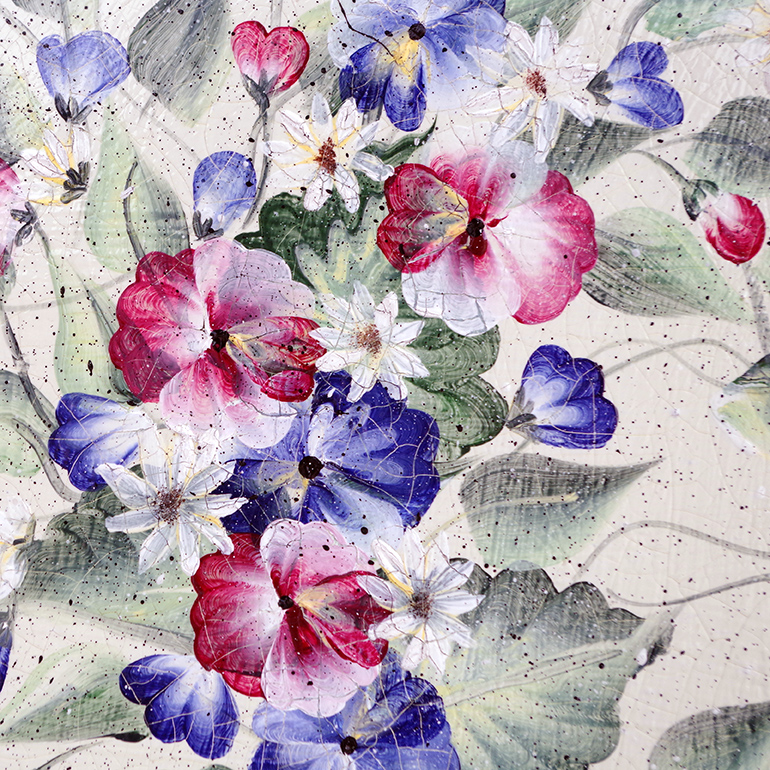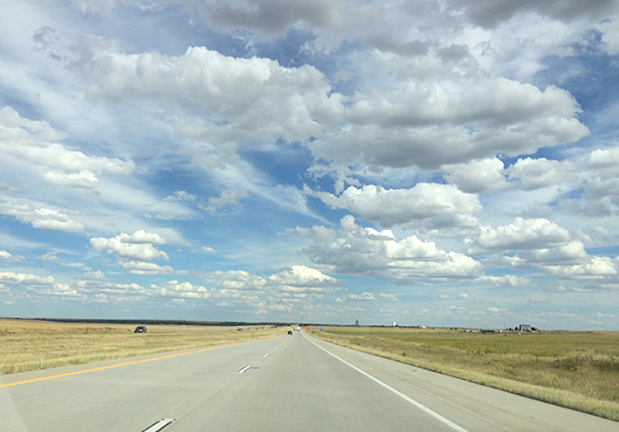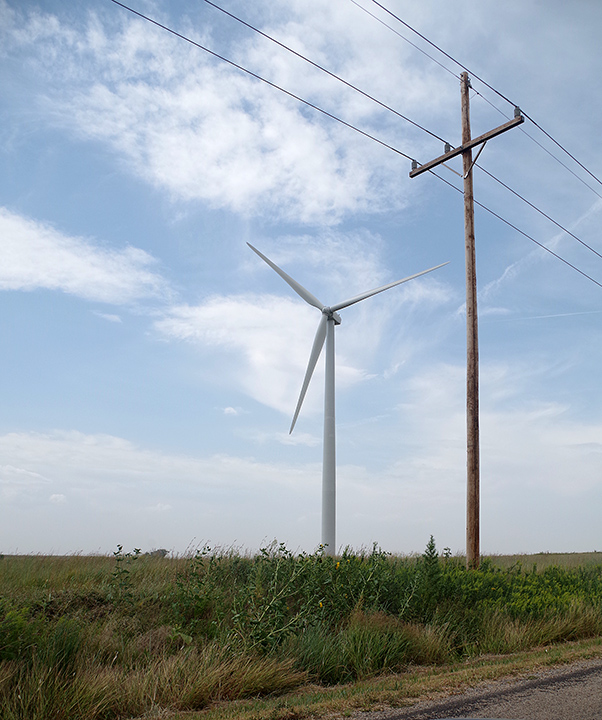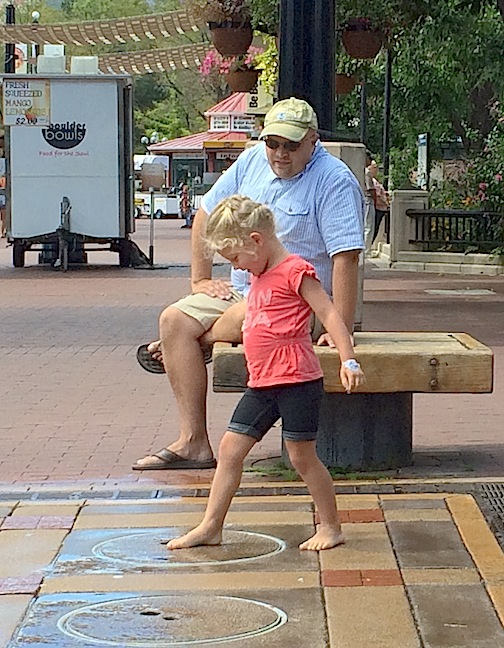
These were taken in one of the galleries of the Nelson-Atkins Museum of Art. I had high hopes for them, but for some reason my iPhone took a sequence of photos at very low resolution, and these were among them. Perhaps I can use these as a group. I did nothing to the files in Photoshop, which is unusual for me. Very often I crop images, and typically I do a little color correction and sharpening.
Author: Marilyn Davis
Dairy Queen bench ~
When I first started exhibiting photographs, in the early 1990s, I used metaphorical names for my abstract and semi-abstract works. In the past few years I’ve turned away from that; now most of my titles for such photographs simply say what things are. It doesn’t always work well, and sometimes I break my new rule. I’m uncertain about whether this photograph should have a different title. It’s a manipulated image of a bench and shadows at a Dairy Queen in Hoisington, Kansas. Pentax K-50, 18-50 mm zoom.
Self-portrait in glass brick ~
Throwing art away ~
No art lasts forever, but some art is much more transient than the rest.
A good friend of mine posted a link on my Facebook page tonight that shows photographs of a Van Gogh painting reproduced large on the landscape via vegetation planted on a 1.2-acre plot. The artist is Stan Herd, who specializes in “land art” designed to be seen from the air. Most of his pieces are eventually plowed under or grown over.
The same transience characterizes the work of the well-known artist Andy Goldsworthy, who works primarily with sticks and stones, leaves, ice, and other materials found in nature. Most of his works are not destined for long life either. They melt, get blown away, wither, or are destroyed by water. Even more transient than Goldsworthy’s or Herd’s works are patterns made by artists on sandy beaches or snowy slopes, some of which last only a few minutes before seawater washes them away or the sun melts their borders.
Some conceptual artists play on the notion of transience by doing conventional work but deliberately planning its destruction. And the very nature of performance art is transience. Only the photographs and videos documenting these various types of art have any longevity, although they too will die some day.
It’s supremely ironic that my friend happened to post this particular link this evening that led me to muse about the transience of art—because this evening, after years of uncertainty, I had finally brought myself to put some art into the recycling bin.
When my husband died, in May 2008, he left behind three big acid-free boxes stacked full with 200 to 300 abstract paintings and other artworks interleaved with acid-free sheets. Most of these works were done with undiluted watercolors on paper. Some were done with ink; some were done via photocopier. Many of the paintings are flaking; some are wrinkled. Some are quite good; many are not, partly because Steve never discarded any of his efforts and partly because his mother and I have skimmed off the cream of the crop. They epitomized Steve as much as anything did. They were the best things he ever produced. To whatever extent anyone has a legacy, they were his legacy. And even though we were divorced a few months before he died, they became unofficially mine upon his death.
At least, I took them. A friend helped me clear out the house that Steve and I once shared, which I’d deeded over to him in the divorce. But neither of us could pry open the high cupboards in the sunroom that I thought contained the boxes of paintings. In a near panic, I dragged in a neighbor who worked and worked and finally got the doors open. I wept in relief. Although I didn’t know what I would do with the paintings, they were the most alive thing left of Steve and they had to be saved.
But where does art go when it has no future?
I framed a couple of the paintings for my house. But Steve and I had no children. He had no siblings. His father died less than five months after he did. In short, after I took the boxes to his mother and let her choose what she wanted, I was at a loss to know what to do with the paintings down the line. Like my own photographs, which will be thrown out or deleted by someone unknown to me after I die, his art has no prospective home.
I’ve kept the boxes for seven years. It seemed unthinkable to get rid of any of the paintings. But I recently told Steve’s mother I would bring them to her, along with the quilts she made us, to ensure that they would still be “in the family” if I died. A smart woman, she hit upon the idea of taking some of the paintings to next year’s family reunion in case any of Steve’s cousins want some of them. She couldn’t take 300 of them, however, and most people don’t much care for abstract paintings. The reality is that most or all of those paintings will be thrown out by someone after my ex-mother-in-law dies.
As I was going through the paintings one last time, choosing a few more that I hate to part with, I found myself putting aside some that I knew would never find a home among Steve’s cousins. Then I began putting aside more that I knew wouldn’t find a home. And finally I assumed the role of Steve’s curator, deciding which paintings were best and which should be sacrificed to make things more manageable for his mother.
Who was I to judge that? But it seemed best for me to do it—a favor, a burden, a debt, an obligation. At one point I just sat down and cried, because it seemed I was discarding his soul, a concept I don’t even believe in. I’m not sure which I was mourning more, the art or the artist. In some dimension, they are one and the same.
The Big Trip: The Nelson-Atkins and a quick sprint home ~

Detail of “Crow Call (Near the River),” Keith Jacobshagen, Nelson-Atkins Museum of Art. The artist is from Wichita, Kansas.

Detail of “Dusasa I,” by El Anatsui, Nelson-Atkins Museum of Art. This work, a showpiece of the addition, is a very large wall hanging, several feet on each side, made of flattened liquor-bottle caps stitched together with copper wire. The artist, who was born in Ghana, now works in Nigeria.
Days 14 & 15: Lawrence to Carbondale.
After an initial delay on Sunday morning, I made it at last to the Nelson-Atkins Museum of Art in Kansas City for my second visit. I spent most of my time in the Bloch Building, the 2007 addition to the museum by architect Stephen Holl. From the street to the east, the addition looks something like a series of connected trailers rising up a hill. But from the inside, it’s phenomenal, with light coming in from windowed towers and interesting angles everywhere. I hate to say this, but I found it far superior to my beloved St. Louis Art Museum’s more recent addition, both architecturally and in the modernist collections that both additions house. I spoke to a museum guard about the photos I was taking of the interior. He pointed out how each gallery opened up a new view via a few steps down into the next, leading the visitor through the building. In fact, he said, a photographer had been there earlier that day on behalf of the architect, who visits periodically.
I’ve included here small, low-res details of four or five of the works at the museum, hoping that constitutes “fair use” for copyright purposes. Most of my time was spent in the modernist collection. I never even made it to the photography galleries (irony!), and though I visited the main sculpture court, which has several Rodins, I was disappointed to have missed the Isamu Noguchi sculpture court. A next visit is in order. I spent my last 45 minutes at the museum trying to track down a still-life of lemons that I recalled vividly from my first trip. (I collect art postcards, and am often vexed that museums so seldom have my particular favorites in their shops.) I asked one guard if he recalled a painting like that. “Let me ask someone else,” he said. “I haven’t been here too long.” I couldn’t tell if he was actually contacting someone on his phone, and I told him Don’t worry, I’ll keep looking. I said I thought it was a European painting, and he said American.
I’d already made a mad dash through the European galleries, so I headed for the American art. No luck. I found another guard and asked her the same question. “Let me ask someone else,” she said. “I haven’t been working here that long.” She said she’d be back in a minute and I sank onto a bench to rest my feet and knees, still sore from the fall at Estes Park. Two minutes later she came around the corner with the first guard in tow. We both started laughing. But the first guard had, in the interim, gotten some information and gave me the exact number of a gallery that featured a painting with lemons.
Well, I’d been in that gallery, and this painting hadn’t stopped me. Memory is a tricky, tricky thing. Either that, or this was in fact a different still-life. It was a fine painting, and I took photos of it, but in my mind a very different painting still exists, with luscious, incredibly realistic lemon slices and…a fish, I think. Hmmm….
At closing time, I headed out of Kansas City for Boonville, where I stayed overnight. The next day, Labor Day, I was home by mid-afternoon, unloading the car and looking forward to getting the doggies out of the kennel on Tuesday. I was very tired, but I’d done my trip. It wasn’t like hiking across Africa or climbing Everest. It wasn’t even Paris. To most people it will seem a very modest achievement. But to me, debilitated after years of depression and anemia, this road trip loomed pretty large as an accomplishment.
I think I’m ready to do it again in a different direction.
The Big Trip: A perfect day in Kansas ~

This through-the-windshield iPhone shot taken somewhere between Junction City and Lawrence, on the eastern edge of the Flint Hills, is so out of focus that it has an impressionistic quality.
Day 13: Colby to Lawrence.
My destination for today was Lawrence, Kansas. From there it would be a quick drive to Kansas City on Sunday. Knowing I had plenty of time, I took back roads much of the day.
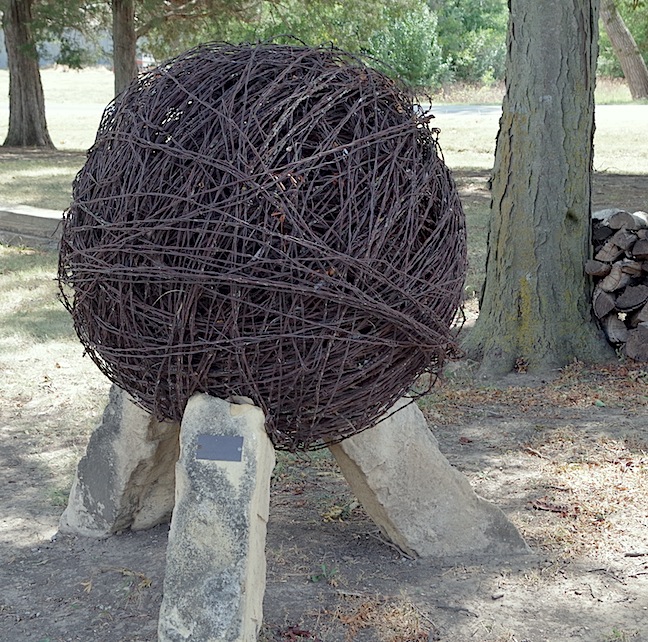
My first stop was at an old favorite: the Kansas Barbed Wire Museum in LaCrosse, Kansas. It was my third visit (I’m not making this up). There was a time years ago, before my late husband and I stumbled upon this place, when I no doubt thought barbed wire was barbed wire was barbed wire. Ha! Not a chance of it, and this little museum, which is always deserted, will set you straight. It has hundreds upon hundreds of variations of barbed wire, plus the tools needed to string and tighten it, plus all sorts of auxiliary items. The director estimates that about 500 patents exist for different types of barbed wire. But each patent can cover hundreds of variations; the total is mind-boggling. One Glidden barbed wire patent covers some 2,400 variations, for example. Among my favorite exhibits at the museum are two barbed-wire tornadoes and a huge crow’s nest made of scraps of barbed wire.
Before leaving, I asked the director where I might get a sandwich to eat. He suggested the Dairy Queen in Hoisington, about 15 miles to the east. It was an inspired choice, because if I hadn’t stopped at the DQ and idly picked up a brochure on the counter, I’d never have known that Hoisington was having a Labor Day festival and that one of the activities was helicopter rides, 40 bucks per passenger.
While I ate my cheeseburger I mulled that over. I’d never flown in a helicopter before, or even been inside one. The prospect was scary, yet enticing. When would I get such a chance again? I could at least look. So when I was done at the DQ, I backtracked, drove through (or rather, around) Hoisington’s downtown, and found the helicopter site. The copter looked awfully small. The pilots said they couldn’t afford to take up just one passenger. Okay, I said, I’ll wait a couple of minutes and see if someone else shows up.
Meanwhile I asked a bunch of stalling questions: Do I weigh too much to go? (Not even close; they could take a 300-pound passenger!) Wasn’t it too windy to fly? (No, helicopters love the wind!) I had fallen a couple of days ago and my left leg was hurting; would I be able to pull myself into the helicopter? (They’d help me!) I sat in my car, still ambivalent. Then a black SUV pulled up: father, mother, son, daughter. The son was first out, and it soon became clear that he and his dad were going up. The pilots waved me over, and I found myself plunking down two 20-dollar bills. I and the boy, who looked to be about 10, would be seated in the back, where there were windows. The pilot (a woman! yes!) and the dad would take the front seats, where there were no doors. “I’m scared,” the boy said matter-of-factly, without any visible sign of anxiety. “I guarantee you I’m more scared than you are,” I told him unwisely. “It’s bumpy,” he said (we hadn’t left the ground, but it did feel bumpy with the engines on). “Should we hold hands?” I said. “I’m going to hold on here,” he said, grabbing the bar between the back of the front seats. I did the same. And then we were up and off!
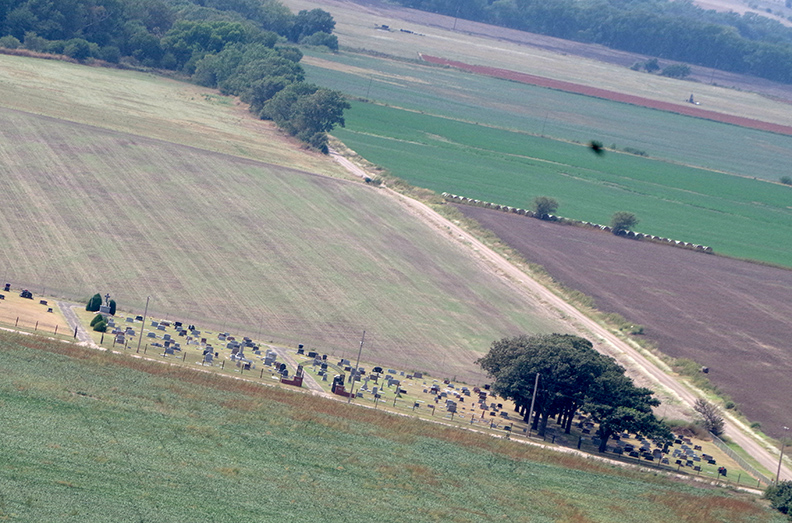
We were all wearing headsets so that we could hear the pilot and each other. “This is awesome!” the kid yelled as we began to fly over Hoisington. I was with him one hundred percent. I believe I might even have added “Woo!!” I was taking pictures like crazy, and the kid and I kept announcing how fun it was. It was wonderful fun. It was even fun when the helicopter banked significantly, though I was grateful I had a window next to me and not an open door. The ride, which lasted only four minutes or so, was far too short. I wanted to keep flying. Heck, I was ready to take lessons. But Lawrence awaited. I waved goodbye to the family, who were in fact from Hoisington, and headed down the road to Lindsborg.
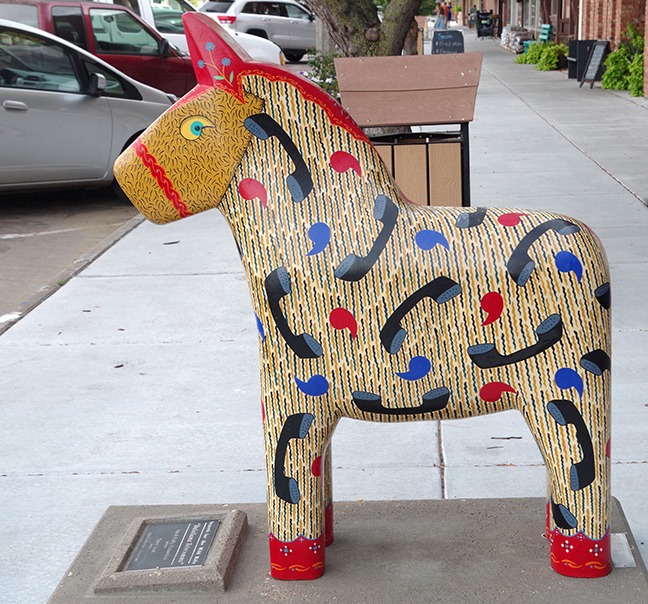
This Scandinavian town was new to me. I got there at 5 p.m., so most places were closed except for an exceptional fair-trade shop called Connected. But Lindsborg hosts a sidewalk herd of painted dala horses. Wikipedia: “A Dalecarlian horse or Dala horse is a traditional carved, painted wooden horse statuette originating in the Swedish province of Dalarna. In the old days the Dala horse was mostly used as a toy for children; in modern times it has become a symbol of Dalarna, as well as Sweden in general. Several different types of Dala horses are made, with distinguishing features common to the locality of the site where they are produced.” In Lindsborg, the paintings on the horses may reflect the business where a given horse is located, or the interests of the sponsors or artist. One thing I noted is that the dala horses, which are chunky creatures, have no tails. I enjoyed photographing details of the paintings.
And then, as I was leaving the vicinity of Lindsborg, serendipity struck. I finally found what I’d been looking for all over Kansas and eastern Colorado: sunflowers! A whole big field of sunflowers with their heads still up (though, oddly, not facing the sun but facing east). I did what I could with my Pentax and my not-so-long lens, trying to get the best photo I could for me and my sunflower-loving friend Dinah.
At Salina I rejoined I-70. The rest of the drive to Lawrence was tedious, but it seemed to me that, all in all, I’d had the best possible day on the Plains.
The Big Trip: The Rockies, and then not ~
Day 12: Estes Park to Colby.
Yesterday evening was the sort of evening that reminded me of the disadvantages of solo travel, and today was the sort of day that made me grateful I was traveling alone.
After splurging on a cabin (technically, I had one-third of the cabin) on Fall River just west of Estes Park, I went into town, had a bite to eat, and then tripped on a step I didn’t see. Down I went on the concrete on my palms and knees. The only thing I remember thinking, other than “I can’t stop myself,” was “How will I get home?” I was close enough to the café to call for help; two of the wait-staff brought me ice and got me to my feet. I found out that I could drive if I was careful. I got back to the cabin just in time to catch the manager, who was on her way out, and she kindly brought me more ice and towels. I spent the rest of the evening feeling thankful that I hadn’t broken any bones or hit my head, and that it seemed I’d be able to drive a longer distance than the three miles from the middle of Estes Park to the motel.
The next morning I headed, somewhat gingerly, for Rocky Mountain National Park. I intended to spend only an hour or so. I wanted to visit the place where my sister and I had scattered our parents’ ashes 12 years ago, but I wanted to leave early and drive as far home as I could, because my calculations had shown me that, once again, I was due to reach Kansas City on a Monday or Tuesday, precluding a return visit to the Nelson-Atkins Art Museum for the sixth consecutive time. So I determined to drive two long days and get to K.C. on Sunday.
In the park, however, I took a wrong turn and found myself heading up into the mountains on Trail Ridge Road. That’s okay, I thought, I’ll just go as far as Rainbow Curve (the second major overlook from the east), see how I handle the altitude, and turn around.
I handled it fine. It felt so good, in fact, and the weather was so cool and delightful, that I made an abrupt change of plan: I’d drive all the way across the park, come down to I-70 on the west side, stay the night somewhere, do things in Denver for a day or two, and stretch out my arrival in K.C. to Wednesday.
By this point in the trip I felt that my 10-year-old Prius and I were practically fused, a virtual woman/machine hybrid. We were at one with each other, it seemed. Until Rainbow Curve. Shortly after I pulled out of the overlook, the car began laboring badly. I nursed it along, hoping it would shake off whatever the problem was. No such luck. At Forest Canyon overlook, 11,700 feet above sea level, I decided to turn around, get the Prius back down to Estes Park, and see if I needed to find a mechanic.
In town I got lunch at a place I’d noticed called “You Need Pie!” Yes, I did: that was truth in advertising. The car had no pie but seemed to be doing better nonetheless, so I headed toward Denver, a route that descends from about 7,500 feet to about 5.000. And soon the car was running normally again. I reverted to my original travel plan: drive like hell toward Kansas City. The car and I ended up in Colby, Kansas, together, reconciled, and back in our own time zone.
Intermission: An afternoon in the Cache River area ~
With luck, I’ll wrap up the Big Trip series this week. This afternoon was a rare day for Southern Illinois: low seventies, sunny, not very humid. Too nice to stay indoors. The shot above was taken from a boardwalk just south of the Cypress Creek Visitors Center. Pentax K-50, 100mm macro lens.
The Big Trip: Hitting bottom and rebounding…artfully ~
Days 7-11: Boulder, Loveland, Fort Collins.
After my day recuperating in Fort Morgan, I headed toward Fort Collins but found that I would get there by mid-morning on a Sunday. So I detoured down to Boulder first, where I spent far too much time and money at the Pearl Street mall. It was a recapitulation of sorts: I went to exactly the same shops as when David and I were there, and I got a veggie panini at the same place we’d eaten. I was disappointed to see that the contortionist who folded himself into various containers, such as a little, clear plastic box, was no longer among the street performers. I wanted to donate to all of the performers, but my cash is dwindling alarmingly fast. I didn’t stay to watch the torch-juggler act, and I didn’t tip the guitarists or the accordion player, and I arrived too late to see a very popular act involving a performer balancing atop a tower of chairs, and I walked past an older gentleman in cowboy garb painted to look like a copper statue, and I skirted the guy in an African-type mask who was playing the bongo drums, and I felt terrible that I wasn’t leaving money for any of them, but there were just so many.
Eventually I sat down near one of the street performers to drink a lemonade and rest my aching feet. This particular guy—I believe it was a guy, though his act was mute—was impersonating a sort of ragdoll dog. His costume was made of tiers of short, pastel-colored pieces of fabric, so he could shake like a puli. He sat like a dog and looked hopefully at passersby. He’d try to attract children by getting up on all fours, or rolling on the ground. A couple of women with a little boy were taking pictures of him, but not leaving any money. That isn’t nice, I thought. I approached the performer and, looking over at the little boy, said, “I think this dog wants a belly rub, don’t you?” The “dog” promptly rolled onto his back. I reached down and rubbed his belly and he made some appreciative doggie-like grunts. “And maybe some scratching around this ear,” I said, still looking at the little group. I scratched one of his “ears” and he pumped one of his legs the way dogs often do when you’ve hit the right spot and they’re just loving it. “See?” I said. “I made him kick his leg.”
I dropped a couple of bucks into the performer’s bowl and then realized that a number of people had stopped to watch this joint act. In one last attempt to get this endearing performer some tips, I put out my hand, and said, “Shake?” He lifted an enormous foot so I could touch the bottom of it. It was more like a fist bump. Still no action from anyone in the crowd. It was a hot day and the street performer must have been terribly uncomfortable underneath his shaggy costume. I felt like whispering to him, “Well, I tried,” but I wasn’t sure if he could hear a whisper inside the doggie head he was wearing, so I just walked away. Ineffectual! Alas.
On the plus side, I was thrilled to see that the problems I’d had with the altitude in 2012 were gone. Three years ago, I’d walk a few feet, then have to rest. Walk a few more feet, then have to rest. Sit down repeatedly. Lean on David’s arm. This time around, I could walk without resting. The iron infusions clearly get credited for this improvement. I sat down only because my feet and legs began to ache almost unbearably. I haven’t built up my endurance very much yet, and they’re not used to this much walking. Added to that stress was driving much of the day without cruise control (I was on a variety of roads, from city streets to the interstate, and the traffic was very heavy everywhere).
In Fort Collins, I was forced to take yet another rest day on Monday. This time I didn’t even leave the motel. I am frightened of my debilitation and I am ashamed of being frightened. I know why I’m here and at the same time I feel I’ve lost sight of why I’m here. I’m reading a book where a man is being “reprocessed,” via amnesia-inducing injections, over and over; we don’t yet know why. Now he has been reprocessed to the point where he has no ambition or autonomy beyond his basic daily functioning, and he will be left to live the rest of his life in the “reprocessing village” (one of many) because he is considered cured. I.e., he no longer poses a threat. To what or whom, we don’t yet know. (To himself, it turns out; the book is called “A Cure for Suicide,” and the cure involves losing all the complexities and nuances and worries of life. I can divulge this because no one ever reads books that I recommend.)
Probably I should not be reading this book right now. It is beginning to affect me strongly. I think that I am like this man, not living a meaningful life. I worry that I’m breaking down, and that would constitute a great failure in my eyes. My sister suggested something I’d already thought of, that I could fly back home and that there are people who will drive your car back for you. But how do you know whom to trust? I would start driving back tonight; since I’ve slept all day I’m confident I could drive all night if it weren’t for the fact that my legs are swollen and hurt very much.
———–
After this, I didn’t do any more writing during the trip, so I’ll sum things up briefly. On Tuesday I felt well enough to continue. I toured three independent-living facilities for my sister, two in Loveland and one in Fort Collins. Then, during a phone conversation with her that evening, I discovered that she didn’t want to live in the Fort Collins/Loveland area, she only wanted to live in Denver, and not in an independent-living facility. This would have been nice to know before I left Carbondale. I was completely open with her about my ideas and my agenda, so I was simultaneously vexed and confused. The trip now seems to have been misguided and misfocused. I considered heading to Denver for the next three days, then realized that Denver would involve a lot of upfront Internet research in order to focus a search. In addition, everyone I’ve talked to has told me that Denver is much more expensive than Fort Collins. Finally, I realized that my energy and navigational savvy simply didn’t extend to a big metro area like Denver on this particular road trip. So I decided to treat the rest of the journey as a vacation.
On Wednesday I met up with my friend David M., dedicated Marlovian and self-described “world’s oldest white rapper.” We stopped by Colorado State University’s trial gardens, where new varieties of garden flowers are being tested, on the way to the big Campbell’s soup can replica that CSU art students constructed to Andy Warhol’s specs and that he signed on a trip to Fort Collins. Dave kept mentioning some black-and-white photos in a gallery that he wanted me to see. Turns out that the gallery was the Center for Fine Art Photography, one of the very places I’d hoped to visit in Fort Collins. Although we arrived just at closing time, one of the curators kindly gave us a personal tour. Then it was on to an Italian restaurant and a quick drive west of the city and up a steep, winding ridge to Horsetooth Reservoir in an attempt to catch the sunset. We were a little late, but the view was beautiful nonetheless.
The arts scene seems to be thriving in Fort Collins and also in Loveland, just to the south. Public sculpture abounds in both cities. Both have taken to painting those big electrical boxes you see all over the place in fanciful, colorful designs, turning them from eyesores into attractions. Fort Collins also paints old pianos with whimsical scenes and leaves them in public places—even alleyways–for anyone to play. In one of the photos above, Dave is trying to talk me into playing the piano so he can get a video of it. So great is my performance anxiety that when I finally sat down, I began “House of the Rising Sun” in the wrong key and never did get straightened out. (Dave, I hope you’ve deleted that video.)
On Thursday I broke my new “vacation-only” rule in order to tour one more facility in Fort Collins, in the interest of doing a reasonably thorough job of what I’d come more than a thousand miles to do, and then toured an apartment complex just across the street. Afterwards, I headed for Estes Park, where I’ll pick this up in the next installment. The writing will get shorter from now on; I promise. We’re on the home stretch.
The Big Trip: Searching for sunflowers; finding sopapillas ~
Days 5 & 6: Hays to Fort Morgan.
Everyone who has flown across the Great Plains has seen the crop circles made by pivot irrigation. They are a potent reminder that we cannot truly grasp the way humankind has remade this planet without seeing it from the air. But we also must see it from the ground—and we can, a little bit, in this case. When you’re driving in Kansas, anytime you see a pivot irrigator near the road, watch as the edge of the crop circle recedes from you on the far side. Often you can see the edge on the front side as well, if you’re paying good attention.
Irrigation circles are plentiful after Hays, which is high-plains country and where you begin to see gates at the entrances to the interstate, to close it off in case of heavy snow. I exited I-70 at Goodland, took an inordinate number of photographs at a Steak ‘n Shake (of all things), and drove back roads north to Haigler, Nebraska, right at the corner of the state. The last part of this drive finally satisfied my need for isolation.
One of my hopes for this trip was to see the fields of sunflowers, the flower that Kansas has made one of its state symbols. Eventually I saw two fields of cultivated sunflowers, but their heads were all bowed down, like a crowd of penitents. Drought? Too close to harvest? I’m not sure. The roads are lined with wildflowers that look like native sunflowers, rather small and not very tall growing, but I was able to get only one decent photo of them.
The county roads in Kansas, or at least this part of Kansas, are lettered rather than numbered. CR X amounted to a pair of barely discernible rutted tracks mounting an arid hill. CR Y seemed like a lament; a few miles later, CR YY seemed like a command. CR Z felt like the end of the world. After I headed west from Haigler and crossed the border into Colorado, I saw that the county roads here are numbered. One of them was CR 92 1/2. I am still puzzling over this and have come up with no plausible explanation for it. How can you have 1/2 of a road? I was hoping things would deconstruct even further, to 1/4 or even 1/8 of a county road, but I never spotted so much as one other 1/2.
I made it to my intended destination, Fort Morgan, Colo., but then I crashed. A pattern seems to be emerging: two days driving and/or seeing “attractions,” one day in bed at a motel. My do-not-disturb sign at this absurdly expensive Hampton Inn in Fort Morgan, Colo., says “Resting.” I noticed that someone else’s, however, says “Relaxing.” They’ve got me pegged. I’m surprised mine doesn’t say “Recuperating” or even “Restructuring.” The door plates here each have a black-and-white photograph next to the number. Mine shows an old-fashioned air pump from a filling station. I’ve checked out eight or nine other rooms and so far each photo is different. A pile of horseshoes. An old church bell. An antiquated alarm clock. A little boy sitting against a bale of hay. A parking meter. I like these.
As usual when I’m exhausted and hurting, depression sets in. After sleeping all day and then texting a good friend for encouragement, I finally pulled myself together around 5 p.m. and went out to eat. At the Acapulco Café I had my biennial BLT (no more bacon for me for two years), which came with fries better than anyplace in Carbondale makes them. And then for dessert I ordered the sopapillas, which can’t be had anywhere in C’dale as far as I know. These were served on a monstrous plate with a mountain of whipped cream in the middle, and they were the best I’ve ever had, even better than the ones at the diner in Santa Fe that I can’t remember the name of that’s just off the market square. I offered to share my order with the only other diners, a young woman and her little girl, who are staying next door to me at the Hampton (I recognized the woman’s dress). She turned me down and apologized in advance for her girl, who was talking incessantly, interspersed with shrieks that reminded me of the birds in Hays. So I ate almost all of them myself. I thought I’d regret it, but I didn’t; I felt just fine. They did me a world of good, I think.
Then I went a block down Main Street (which does not seem to be thriving here in Fort Morgan) to the old-fashioned movie theater. I could have seen “Straight Outta Compton,” which seems like a hilarious choice out here on the high plains, but instead I went with “Ricki and the Flash.” It isn’t a well-written movie—1970s rock ‘n roll really isn’t the quick fix for a rock-bottom relationship with the mother who deserted you when you were young—but Meryl Streep is a good singer and she learned to play the guitar for this movie, at least enough to get through the 11 songs she had to perform. Her singing was the part that interested me enough to pony up the eight bucks this small-town theater must charge just to survive—that plus the fact that I didn’t want to see any of the other three movies playing. I talked to the theater owner for awhile; he and his movie house are hanging in there, he says.
And then I did my laundry at the Hampton. Given that I plan to shorten the trip considerably, I may not have to do laundry again until I get home. So hurray for that.
I’ve been plagued with memories ever since I left Lawrence. I crossed Kansas once with my first husband, several times with my (now-deceased) second husband, and once with a (now-deceased) boyfriend, and it saddens me greatly to think of all of that potential life lost. Two of those trips were occasioned by my parents’ deaths. It will soon be September 8, the day Mom died 18 years ago. If I had had a baby that year, that child would be going off to college now. It’s a fact that almost stops my breath. I’m a ruminator by nature, and the comparative isolation of the Great Plains reinforces that tendency.