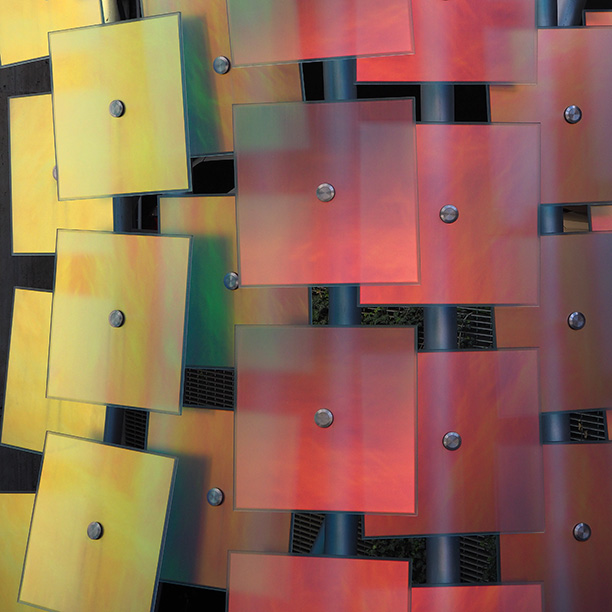
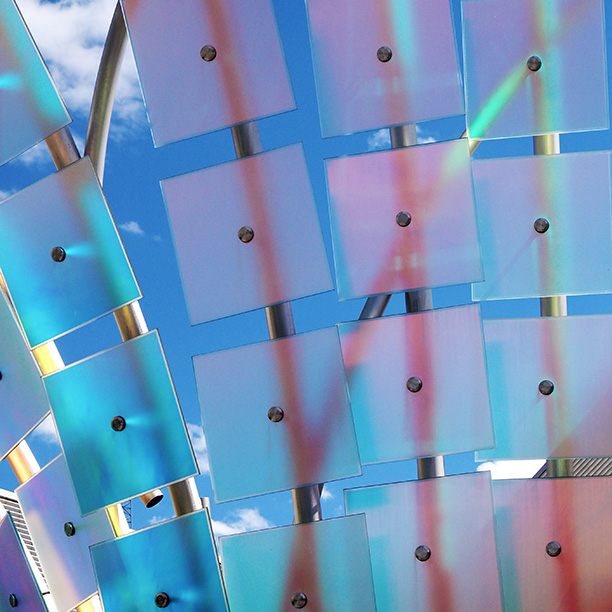
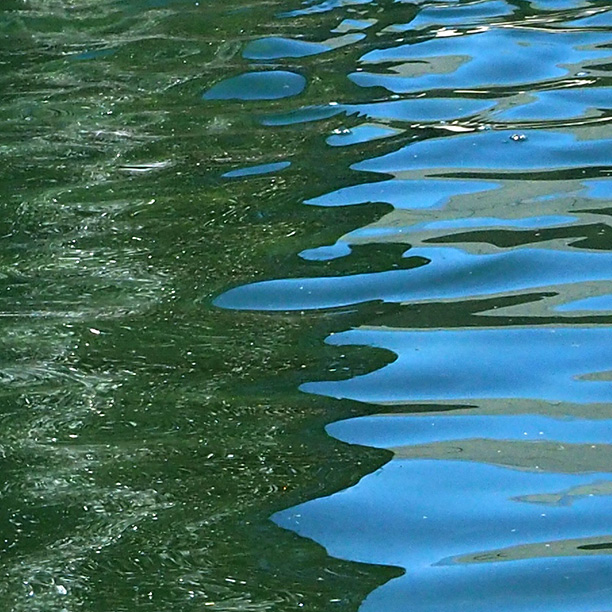
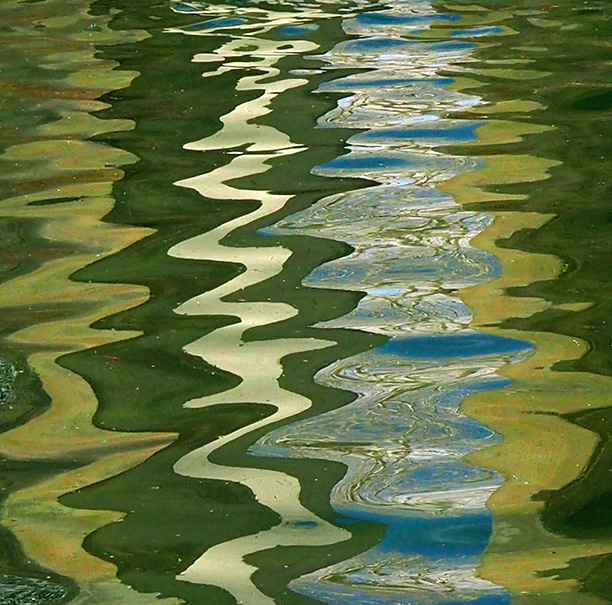
In tiling these photos, WordPress has made the big small and the small big. It’s fitting. This landscape is so vast that gigantic land formations, even mountains, are small on the horizon when seen from distances of 20, 50, 100 miles. And only when you take the time to pay attention close at hand do you realize how many plant species are blooming all around you, dwarfed by the rock.
Art
Water abstract ~

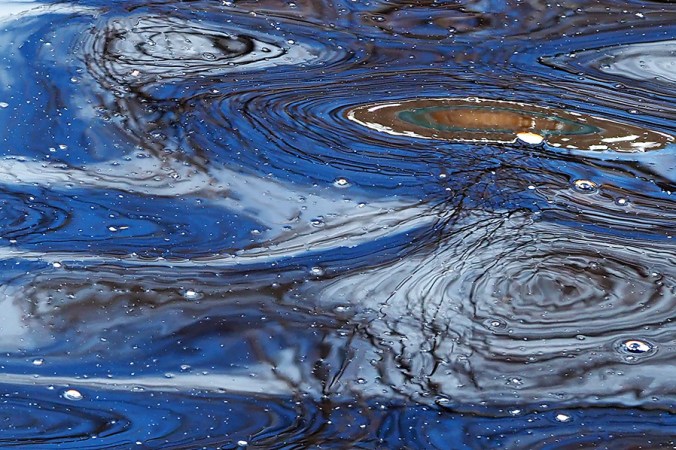
A few days ago I said I was finished posting photos from my trip to the Denver Botanic Gardens. At the time I thought that was true, but I was mistaken. Here’s one last photo of water reflections. I like it better than most of the others I posted. I intensified the colors, but not dramatically.
All about light ~


Here are two details from “Albedo” (2010), by Osman Akan. “Albedo” is a two-story-tall sculpture installed in an open area of the parking garage at the Denver Botanic Gardens. It’s made of dichroic glass panels affixed to long, vertical, curving steel tubes. As the identification sign explains, “Albedo is the measure of how strongly an object reflects light. It is an important concept in climatology, astronomy and computer graphics—a relevant combination of disciplines for the Gardens and for Akan, whose art specializes in the physics of light.”
At 3 p.m. on April 2, the sculpture was casting teal shadows on the wall behind it. I didn’t get a good photo of that, so I need to go back. It would be interesting to document how the color and intensity of the square panels change throughout the day, how they vary from sunny to cloudy days, and how they alter over the seasons. I also want to take photographs of this sculpture from which I can isolate even smaller details. I find the colors and the overlapping forms almost hypnotic in their effect.
Water reflections ~


Taken at the Denver Botanic Gardens. Images cropped and colors over-saturated.
Water bubbles ~

Taken at the Denver Botanic Gardens. This is a very small section of the original, slightly color-intensified.
Up the down staircase ~

Staircase at the Spencer Museum of Art, University of Kansas.
I’m here ~

It was a lucky break that the young man decided to interact with the video art just as I was taking this photo from the second floor overlook. Main hall of the Spencer Museum of Art, University of Kansas.
Let sleeping cats lie ~

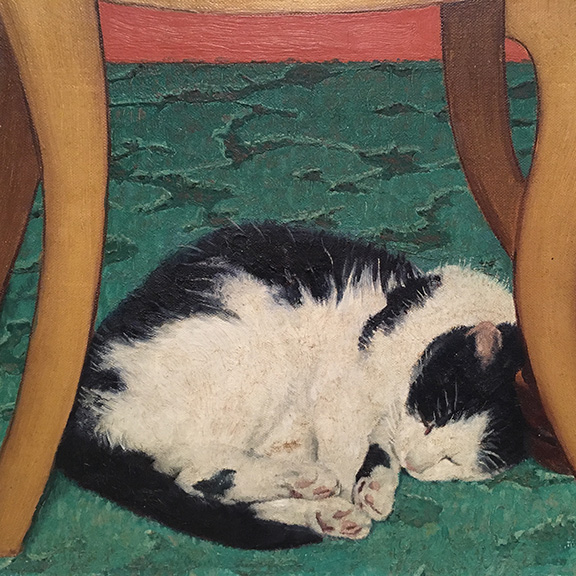
Despite the recent elevation of Norman Rockwell’s reputation in the art world, he’s still not my cup of tea, and I still see him more as an illustrator (albeit a superb one). But there are definitely things to admire about his art. For example, in his painting “Facts of Life,” which shows a father telling his embarrassed son about the birds and the bees, he has included a sleeping cat (shown above) under the father’s chair, and kittens playing on the boy’s chair. It’s subtext par excellence: a sly way of directly depicting the very topic—sex and reproduction—that is being so earnestly discussed in the abstract. It also cleverly pairs the adults (man and cat) and the young’uns (boy and kittens): experience on one side of the painting; innocence on the other. The boy might well envy the kittens for not having to endure an explanation of what’s eventually coming (pun intended).
This work is in the collection of the University of Kansas’s Spencer Museum of Art. See the full version at https://www.wikiart.org/en/norman-rockwell/facts-of-life.
The hand that holds the handkerchief holds the power ~

This is a small detail of another painting in the collection of the Spencer Museum of Art, University of Kansas. The painting, done sometime between 1610 and 1628, is a portrait of Maria Maddalena, Grand Duchess of Tuscany and Archduchess of Austria. The duchess and her mother-in-law ruled Tuscany as co-regents for several years after the death of Cosimo II de Medici. In this detail I especially like the exquisite depiction of the lace bordering the handkerchief.
Crawfish, I guess ~

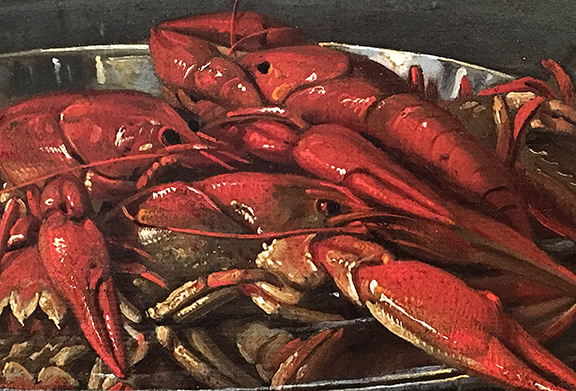
I’m going to return to museums for a few posts now. This is a small detail of a large painting by Cristoforo Monari (1667-1720) titled “Still-Life with Dog and Fruit.” Given the scale of various objects in the painting, I’m assuming these are some kind of crawfish rather than lobsters. (Someone more familiar with crustaceans will undoubtedly be able to set me right.) I must say, the one in the front looks rather fearsome. The work is in the collection of the University of Kansas’s Spencer Museum of Art.