Red stroke ~

Red stroke

Red stroke

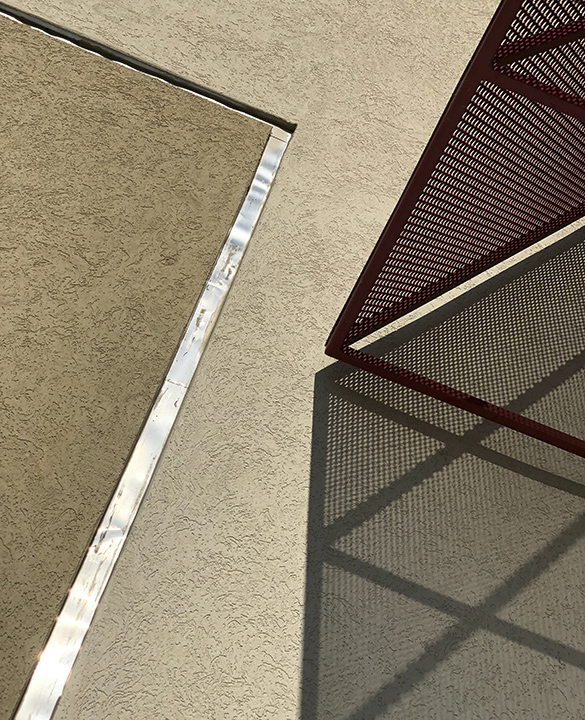
When I’m painting (which I don’t do often enough), I use a pie tin for mixing the acrylics. After the paint is dry in the tin I can usually peel it off in large pieces, which I then photograph. This is my favorite of the palette photographs I’ve taken. It’s what I’d like to achieve in painting, but haven’t figured out how to do.

Christmas meets West Side Story. Plus, birds! ~

It’s the Sunday after Thanksgiving. Like every town in America, Loveland has blossomed out with Christmas lights. Tonight I saw that the Outlet Shops of Loveland have assembled their annual Twelve Days of Christmas display, in which the hens and the maids and the drummers are outlined by strings of lights. From side angles the hubbub appears as a bright chaos, but as you drive along, the apparent disorder resolves into figures—78 in all, which certainly should be enough to satisfy any holiday shopper or child.

The lords a-leaping immediately put me in mind of one of America’s favorite musicals. Take a look. Except for what appears to be a fatuous grin on the face of the red-shirted guy, I see the Jets here, or maybe the Sharks. Jerome Robbins lives in Christmas lights!

Lords a-leapiing

Lords a-leapiing

The five gold rings weren’t any great shakes, but I very much liked the seven swans a-swimming and the six geese a-laying. One of the swans appears to be het up about something. Note that apparently only one of the geese a-laying has produced eggs, but she’s balancing atop 21 of them, which is quite an achievement. Whoever designed this display had a sense of humor. One of the eggless geese is looking back with envy, or possibly pique, or maybe just grudging admiration.

Swans a-swimming

Swans a-swimming

Geese a-laying

Geese a-laying

These iPhone photographs aren’t very good, alas. It was cold, and I opted for taking pictures from the warmth of the car. The technique definitely suffered (there was actually no “technique” to speak of, and almost nothing in the way of composition either). But my fingers stayed warm.

In hot water one more day ~

This too is Yellowstone

This too is Yellowstone

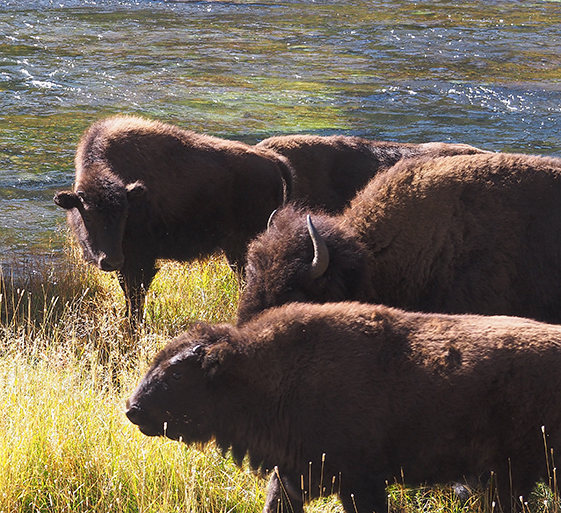
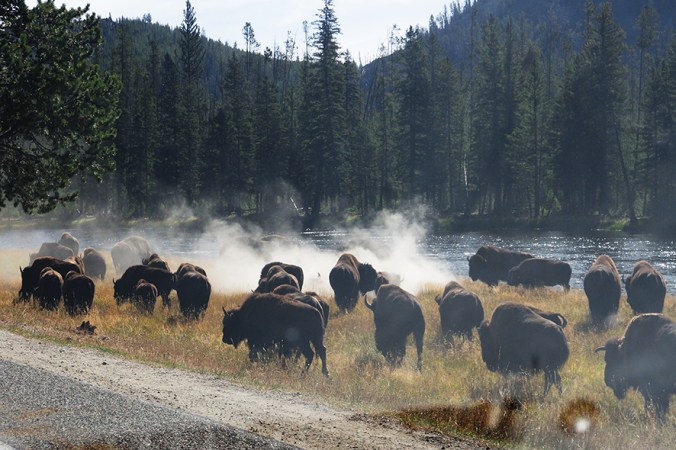
Buffalo herd by the Madison River

Buffalo herd by the Madison River

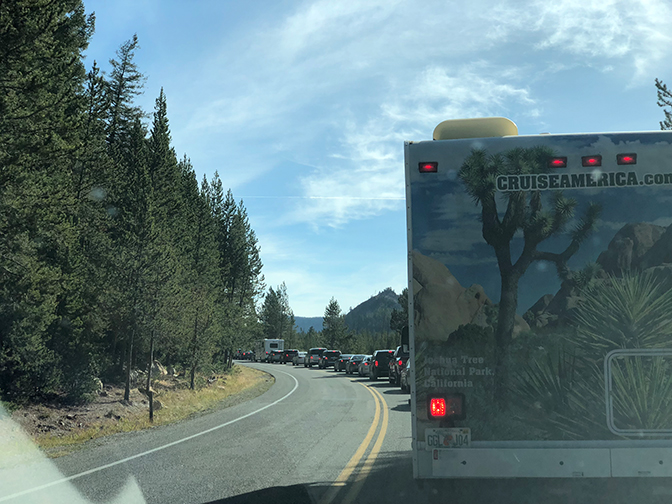
Through the windshield

Through the windshield

My second full day in Yellowstone started with a traffic jam. After half an hour of inching along the road, I finally saw the reason for the hold-up: A entire herd of buffaloes was moving east between the road and the Madison River. Some of the buffaloes had found a nice place to roll cumbrously in the dust. Two males decided to spar. And I spotted a still-reddish baby buffalo in the group. If I’d been sitting in the passenger seat I could have reached out and touched some of these animals. As it was, for many of the photos I took I had to hold the camera up high to keep buffalo heads from being obscured by the door frame. And so, like everyone else on the road, I contributed to the traffic jam.

After the buffalo jam I hoped to visit a favorite of mine, Grand Prismatic Spring, but I gave up—cars spilled over from the parking lot all the way to the main road and more. Instead I spent an hour or so on Firehole Lake Drive, where there were few people but several interesting geysers and pools.

In the meadow between the geyser area and Firehole Lake, I stopped by this small stream and dipped my hand into the water. The morning was in the 40s, but the water was quite warm from the geyser runoff.

Stream, Firehole Lake Drive

Stream, Firehole Lake Drive

Eventually I drove south to West Thumb Geyser Basin, on the edge of Yellowstone Lake. From here you can see hot springs, geysers, the lake, and the distant mountains all in the same view. It was tough to get people-free shots here, because the boardwalks were crowded with selfie-taking tourists—a people jam. But it was worth the jostling to see the lake and the brilliant colors of the two pools below, the most beautiful at West Thumb.

I walked twice as far as I expected to at West Thumb. As I was heading back to the car from the lake, a ranger closed the boardwalk ahead of me because a group of elk were getting too close to the crowds, or vice versa. I backtracked along the lake all the way around to the other side of the basin—where people also were, you guessed it, being turned back toward the lake because of a large bull elk. So I backtracked over my backtrack and found a middle route up the slope.

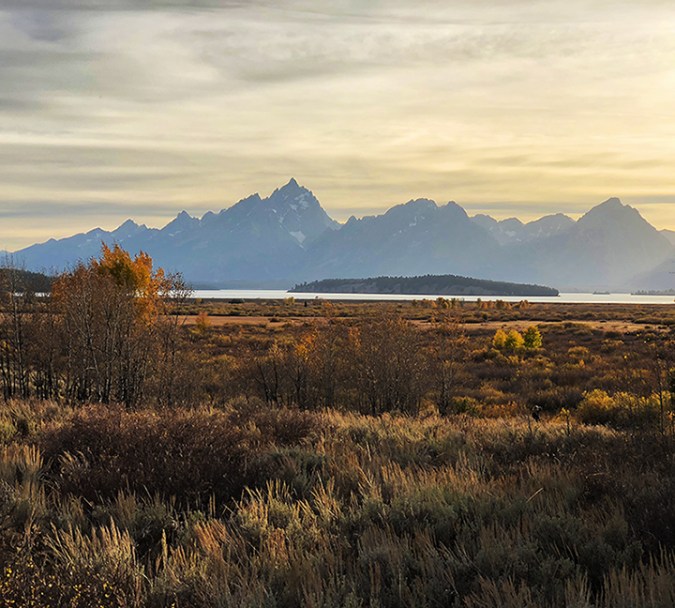
At this point my feet were aching and I was extremely glad that I’d packed cheese and crackers and grapes in the car. Despite the crowds, some of the restaurants in Yellowstone had already closed for the season. After my early picnic supper, I drove down to Teton National Park, where the blinding sun just before sunset rendered the mountains extremely hazy. The photo below, considerably tinkered with in Photoshop, was the best I could do, which is not saying much. After getting lost a bit, I discovered that my motel for the evening—actually a cabin at the Togwotee Mountain Lodge—was about 15 miles east. And so I ended up not really seeing the Tetons on this trip. After several sleepless nights and lots of walking, I knew I needed to head home the next day.

Tetons at sunset

Tetons at sunset

But in the morning, before continuing east, I drove back about five miles west for a last glimpse of the mountains. And a wonderful visual effect occurred: As I rounded a curve, a mountain came into view on the horizon. Then another one, taller. Then another one, still taller. As the road continued curving, to my astonishment yet another mountain, massively tall, appeared. The Tetons are familiar to most Americans from countless movies and photographs. I’ve seen them on a couple of previous trips. Yet, like the Grand Canyon, they surprise you every time in person. I hope to go back.

Distant view of Tetons

Distant view of Tetons


A garden side note ~

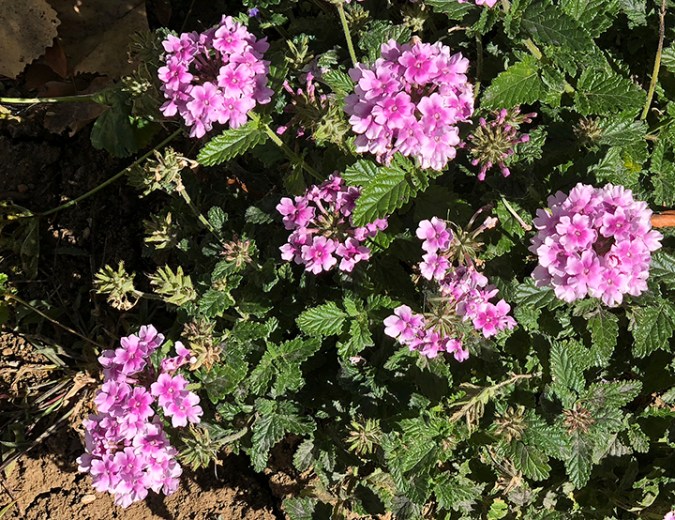
Verbena

Verbena

Balloon flower

Balloon flower

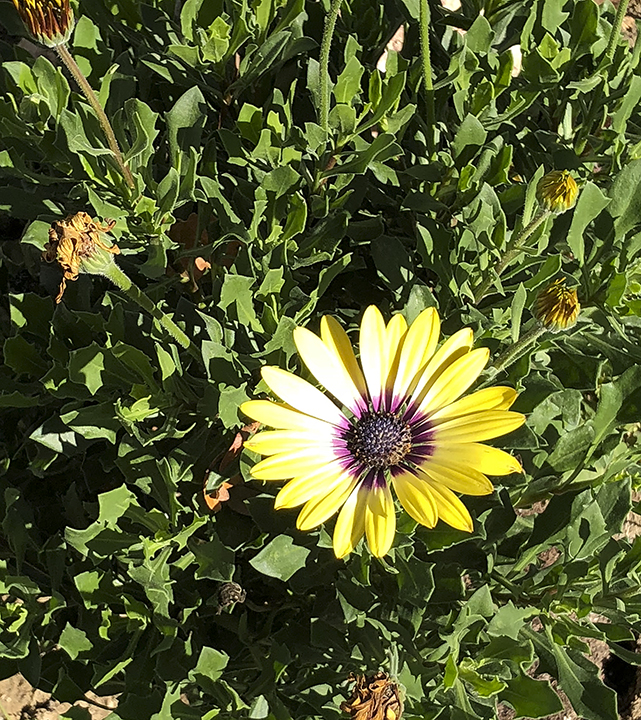
African blue-eyed daisy

African blue-eyed daisy

Purple dalmatian foxglove

Purple dalmatian foxglove

On October 13 in Loveland, Colo., the day before a hard freeze and a six-inch snowfall, the flowers I’d planted on the west side of my house were still going pretty strong. That was no thanks to me, since I’m a novice gardener and not strong enough or educated enough to do the proper things, like amending the soil and fertilizing. (All I know how to do is buy the plants at Lowe’s and plop them into the dirt.) But these flowers have been very forgiving of me for the past few months. I was especially surprised to see foxglove blooming in October. And even now, on October 24, after the snow and the cold, the verbena still has blossoms. Even if the perennials among these don’t overwinter, I’ve gotten my money’s worth of enjoyment out of them.

Nasturtium up close and personal ~

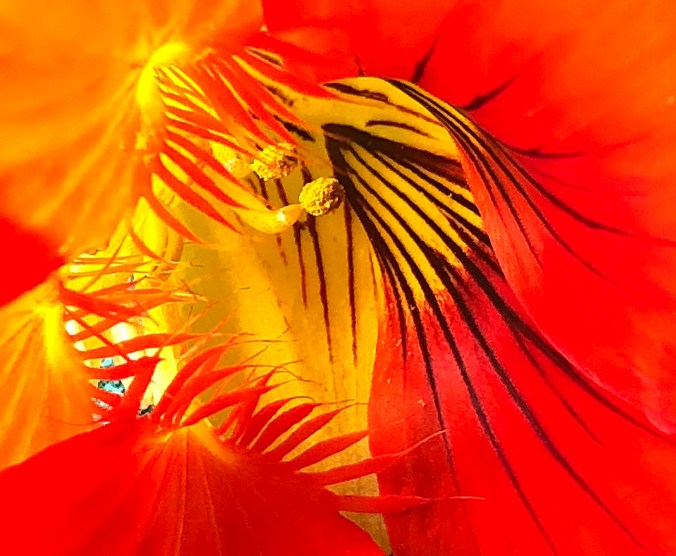
Nasturtium

Nasturtium

This nasturtium graced my breakfast plate at the Regis Café in Red Lodge, Montana. I don’t recall ever having been served a flower before. A fellow diner told me that nasturtiums are delicious, but I just photographed mine with my iPhone and then took it in the car with me.

Not just dinosaurs ~

Hypacrosaurus

Hypacrosaurus, a duckbill dinosaur of the late Cretaceous

The second day of my trip I also went to the Wyoming Dinosaur Center, in Thermopolis. Unfortunately, I was so sleep-deprived that I couldn’t do it justice, which was a shame. This is a fantastic museum house in what is essentially an enormous pole barn. Why is something like this in Thermopolis? Because dinosaurs are being excavated here! The center raises donations to support its excavation work on a nearby ranch, as well as its preparation work, which museum visitors can observe through viewing windows. They’re planning for a beautiful new facility where they can better house their fossils and fossil replicas, and they have lots of both. Visitors also can pay to assist at the dig site, which in turn supports the scientific work.

Not just dinosaurs are on display; the museum is organized to show the progression of evolution from early organisms through the age of the dinosaurs, birds, and early mammals. I found myself wishing I had the time to read every single interpretive sign. Most of these iPhone photographs are of actual fossils, not replicas.

Fossil brittle stars

Fossil brittle stars – Wyoming Dinosaur Center
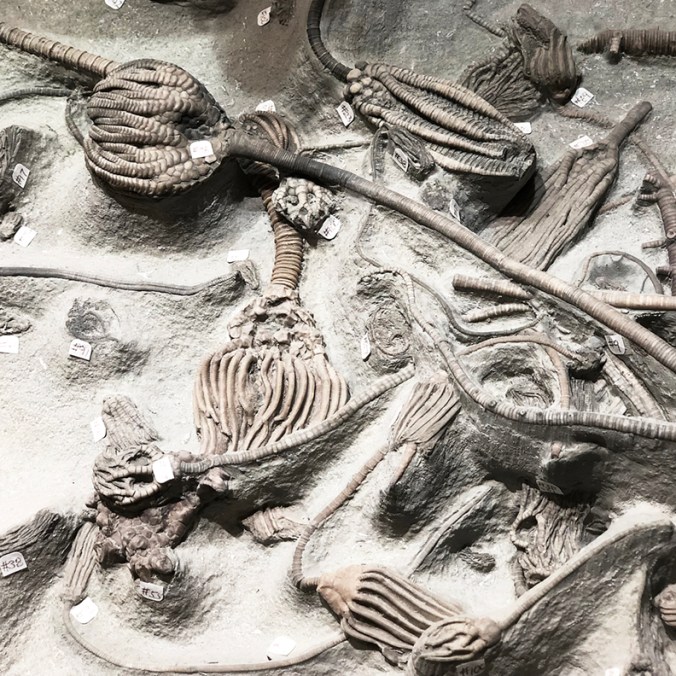
Fossil crinoids

Fossil crinoids (sea lilies) – Wyoming Dinosaur Center

An especially prized fossil here is this one from China, of Microraptor, a small dinosaur with feathers not just on its arms but also its legs. You can see the impression of the feathers on all four limbs and also at the end of the tail.
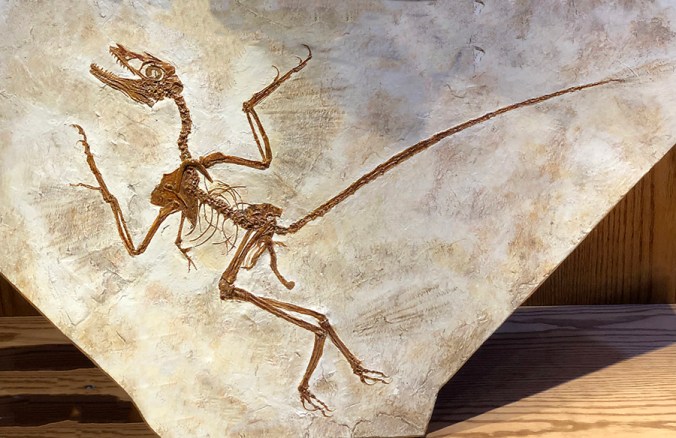
Microraptor

Microraptor, a small dinosaur with feathers on all four limbs – Wyoming Dinosaur Center

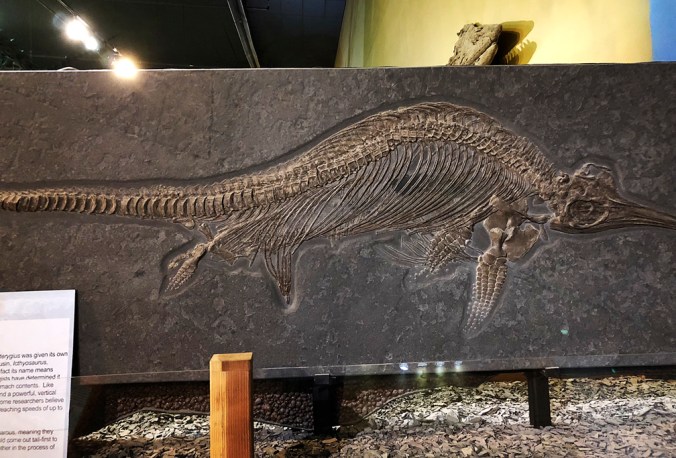
The museum has plenty of large, complete dinosaur skeletons. Among the smaller dinosaur fossils is this beautiful specimen of Stenopterygius, a Jurassic-age ichthyosaur. But not just any old Stenopterygius. To quote the interpretive sign: “Ichthyosaurs are vivaparous, meaning they give birth to live young instead of laying eggs. The baby would come out tail-first to prevent them from drowning. This specimen preserves a mother in the act of giving birth.” Wow! And indeed, in the second photo below you can see the baby’s skeleton dangling below the mother. I’ve also included a shot of just the head and upper body because it is so gorgeous.
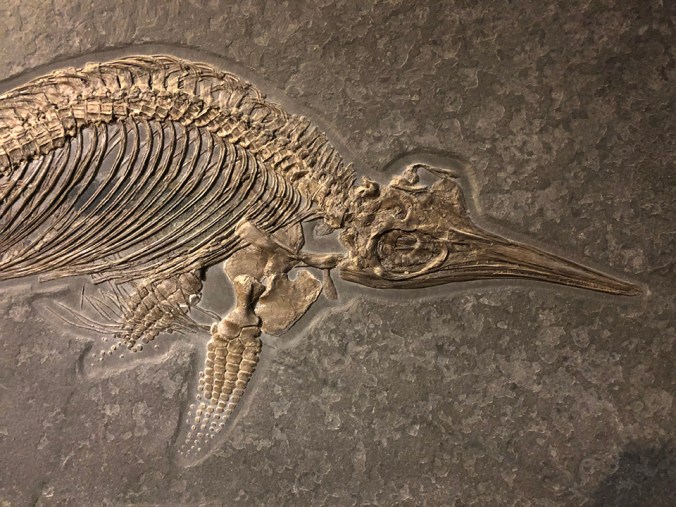
A female stenopterygius...

A female stenopterygius…

...in the process of giving birth!

…in the process of giving birth! – Wyoming Dinosaur Center

Another surprise: Fossilized dinosaur embryos and a reproduction of a nest of baby dinosaurs.

Fossilized dinosaur embryo

Fossilized dinosaur embryo – Wyoming Dinosaur Center

From tiny to enormous: Kids will love the big dinosaur skeletons.
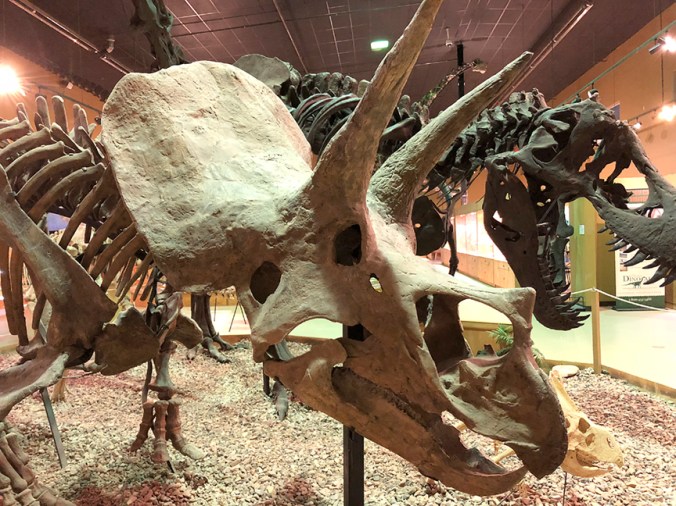
Triceratops horridus

This Triceratops horridus skeleton is the actual fossil, not a replica – Wyoming Dinosaur Center

Pliosaur

This head belongs to a complete replica Pliosaur skeleton – Wyoming Dinosaur Center

I’ve been in a lot of natural history museums, so it’s possible I’m just forgetting, but to my knowledge I’d never seen a fossilized mortichnial trackway before. It’s the track or footprints of a dying animal—in this case, the final 32 feet of life of a horseshoe crab, which extended across nine large excavated panels on display. This particular exhibit, more than any other at the center, really brings it home to you that all these animals once were as alive as you are now.
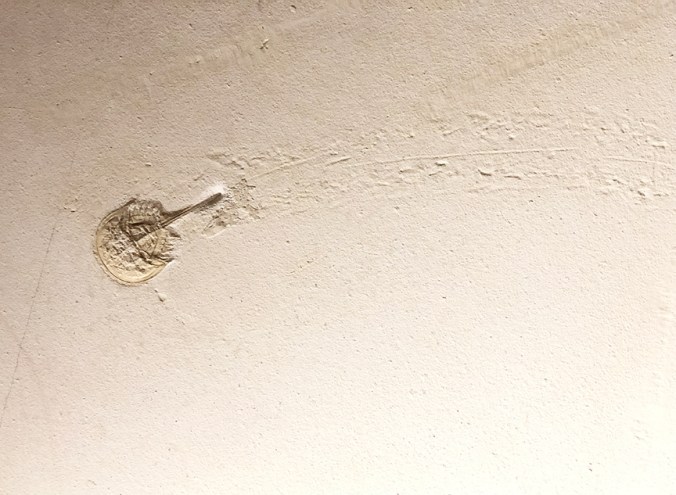
Fossil horseshoe crab

Fossil horseshoe crab and last segment of mortichnial trackway – Wyoming Dinosaur Center

I’m no paleontologist, but I can hardly say enough good things about the Wyoming Dinosaur Center. It’s only a six-hour drive from Loveland, not counting stops, and I’d gladly make a special trip just to visit here again. I didn’t notice any “No photography” signs, so I’ve taken the liberty of posting all of these photos as a kind of advertisement for the center. Long may it live!

Fossil of whiptail stingray

Whiptail stingray – Wyoming Dinosaur Center. I don’t know what exactly all those filaments are, but the beauty of this 50-million-year-old fossil blew me away.
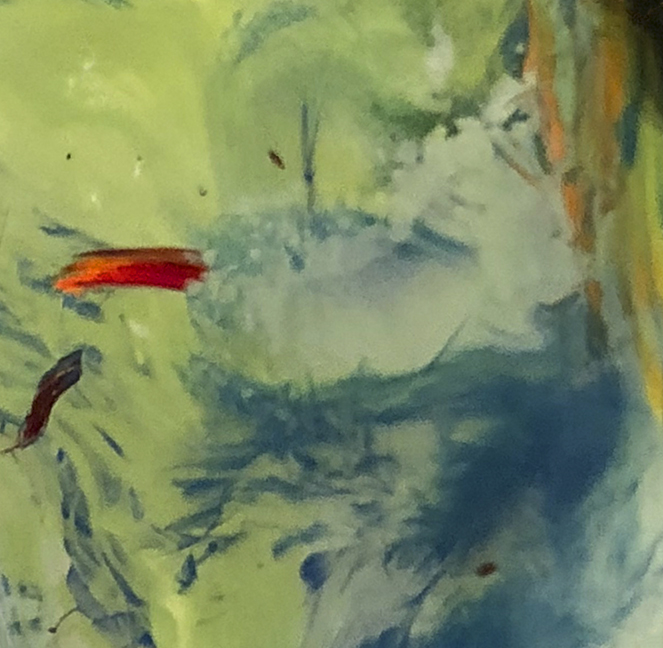
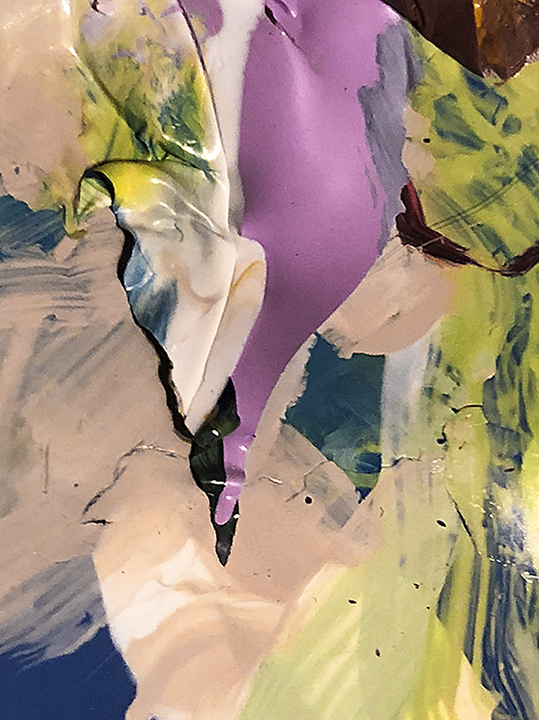
Not scenery ~

Some non-scenic sights from my recent road trip to Wyoming/Montana.


Solitude on the high plains ~


This afternoon I drove up to Soapstone Prairie Natural Area, located about 15 miles north of Fort Collins and about 10 miles south of the Wyoming border. The last several miles are on a very well graded dirt-and-pea-gravel road. I went to the north parking lot, where there was only one other car, and walked a short trail to a site that overlooks a former archaeological dig, now restored to prairie. This is some of what I saw. I’m still working on an identification for a couple of the plants. I’m also a bit puzzled by the rocks atop the fenceposts—are they decorative, or do they have some sort of significance I can’t read?

The sense of remoteness and the solitude were gratifying, very different from the isolation of being at home. It was a beautiful, unusually cool day for August and it was windy; my ears actually got cold. I was fine in a T-shirt but began thinking longingly of earmuffs; what a strange sight that combination would make! A hat or scarf would have done the trick. I want to return to this area soon with my Olympus and my binoculars.

Note: I have since learned that the purpose of the rocks is to divert water, thus preventing deterioration of the tops of the posts. Thanks to Michael Bliss for telling me this.