
Crested oropendola
That bright blue eye!
Crested oropendola
That bright blue eye!

Hawk-headed parrot
Another bird species that inhabits the Amazon rainforest. I finally had the luck of getting a catchlight in the eye, because this enclosure was so well lit.

Spangled cotinga
This little tropical fellow (only the males boast the brilliant turquoise-and-jade plumage) has a most excellent name. The word cotinga comes via French from the Tupi, an indigenous people living in what is now Brazil. (Interestingly, Tupi is also the name of a software program for 2D animation whose logo is very reminiscent of cotinga plumage.) There are several other species of cotinga, too, all of them gorgeous and apparently much sought out by bird-watchers.
Some good news: Wikipedia says that the spangled cotinga is “not considered to be threatened because of its wide distribution.” It lives in the rainforest canopy, however, so I hope this status continues despite deforestation, which does threaten some other cotinga species (again, according to Wikipedia). No bird species should be lost if it can possibly be helped—but especially not such a beautiful one.

White-faced whistling duck
I probably shouldn’t post something this blurry, but I liked the spunkiness of this lovely duck. He/she lives in a walk-through room in the Denver Zoo bird house, with roommates that include members of several other bird species and even a couple of sloths slung like bundles of rags high in the branches of a tree.


Well, no bones except in the clownfish. Sometimes I wish I had been a marine biologist studying invertebrates. These photos remind me of the old aquarium in La Jolla, California, right next door to the Salk Institute. That little Art Deco building housed a circular array of only a dozen or so medium-sized tanks, and those tanks were filled with anemones of many colors. The effect was breathtaking. These iPhone photographs were taken at the Denver Zoo’s Tropical Discovery building.

lionfish
My 60 mm lens, despite its wide aperture, simply couldn’t let in enough light to capture decent photographs of the animals in the dark tanks of the Denver Zoo’s Tropical Discovery house. Things improved after I switched to my iPhone. I’m frequently disappointed in the performance of my iPhone’s camera, and then it pulls off something like this. A biological note: Lionfish, like so many other beautiful invertebrates, reptiles, and amphibians, are venomous.


No leaping going on while I was present. I hope to return to get some sharper photos and get down a couple of identifications that I missed. Although a crocodile is technically not a lizard, I figure it’s close enough to fit with the rest of these. Although the one here appeared positively blissed out, there’s really no other way for a crocodile to look when its mouth and eyes are closed, is there?
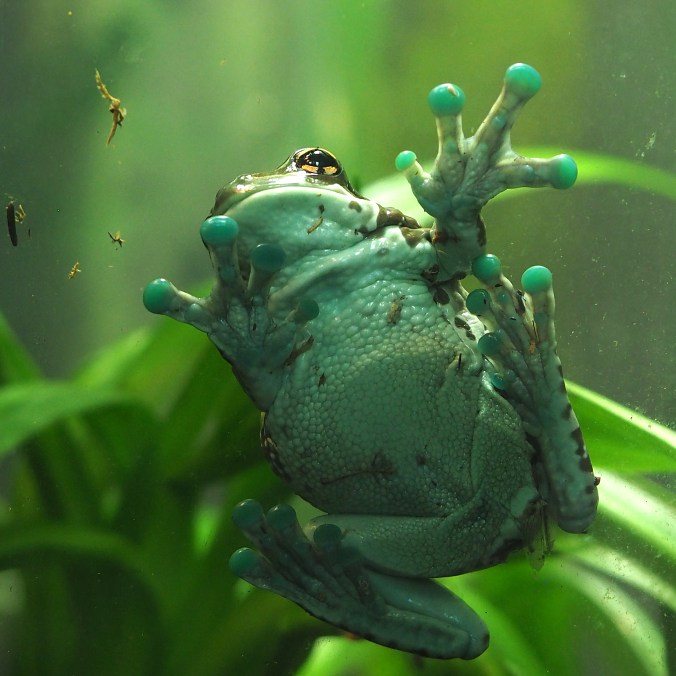
Amazon milk frog
Now for an excursion into the humid hallways of “Tropical Discovery,” the facility at the Denver Zoo that houses reptiles, amphibians, fish, and a few invertebrates. Despite the name, some animals here are not tropical species—but this lovely jade-colored frog is.


Of all the animals I saw at the Denver Zoo (and I didn’t get around the entire zoo), only the eland was bold enough to stand right at the front of its enclosure, getting a great deal of pleasure from rubbing its chin and neck against the scratching post and the enclosure cable. The okapi, with its gentle-looking eyes, beautiful brown coat, and modernist black-and-white legs, is one of my favorites. In-between shots, this one was munching grass. A check of Wikipedia reveals that okapis, which are endangered, are quite solitary, are most closely related to giraffes, and are “generally tranquil.” This female seemed pretty unperturbed at my presence.
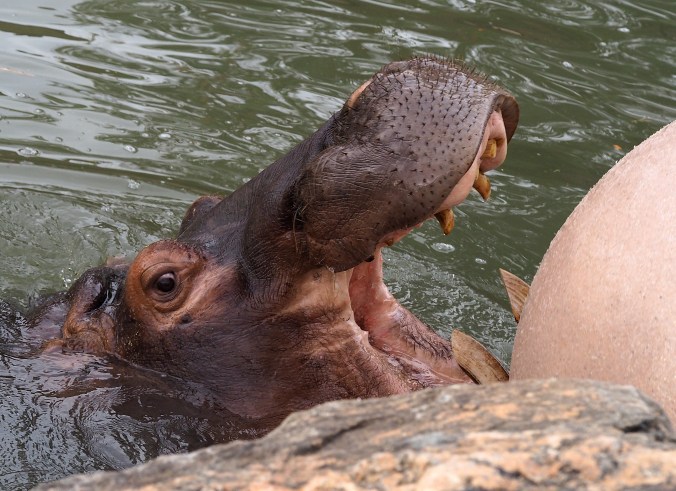
This hippopotamus wrestled her ball all around her little pond, trying to bite it (apparently). She’d go underwater for several seconds and then re-emerge to engage the ball again. As I think I mentioned a couple of posts ago, I have mixed feelings about zoos. I used to think they were important for conservation efforts and education, but I recently read a New Yorker article that rather convincingly refuted that argument. The obvious boredom of many of the animals, despite “enrichment” items such as balls and other toys, pains me. I don’t so much mind seeing fish or reptiles or amphibians in tanks (some photos of those later), but for mammals the Denver Zoo strikes me as a rather sad place.
I don’t actually know that this hippo is a female; I’m just guessing. Her/his teeth, especially those tusk-like lower canines, serve as a reminder that hippos are the most dangerous animal in sub-Saharan Africa (other than humans themselves) in terms of the number of people they kill. So I’ve read, anyway.
 VAPOR AND FLOW