Note: This is a very long post, but for me it is a necessary tribute and a necessary corollary to an earlier post. A handful of Facebook friends will have read parts of this essay on the FB memorial page I set up for Steve.
In my post Into the Confessional I talked about the death of my second husband from alcoholism and my responsibility for his death. But “alcoholic” carries such profoundly negative connotations that it obscures the person who suffers from the disease. I would hate for anyone to think “Steve = alcoholic.” He was smart, funny, creative, nice—and a true original who had more peccadillos than an armadillo (one of our favorite animals). I’ve never known anyone like him.
Steve was the type of person who always stopped for road-crossing turtles and moved them where they were going, no matter how much peril this entailed for our own car. He loved animals, all animals. In his last few years he became a vegetarian, a choice that perplexed his parents and took them about three years to accept. He had a multi-volume animal encyclopedia that he often browsed through, and he’d frequently show me a picture of something like a naked mole rat or a fennec and insist, “I need one!” I liked the animals he showed me too, but I had to tell him no, which made him pout.
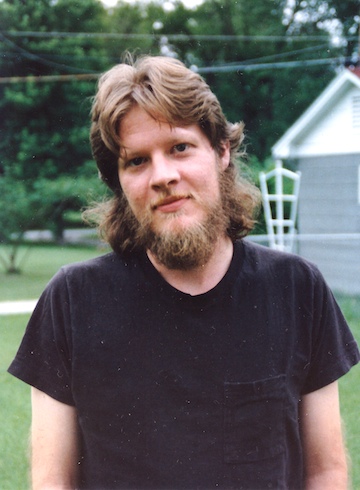
Steve, age 32
In the early 1980s Steve co-managed a used-record store in St. Louis and then one here in Carbondale. He was an expert on rock, jazz, and avant-garde classical music in particular. As a young man, he worked for a time as a janitor; with a St. Louis friend, he recorded three albums under the name The Janitors. He came to believe that Bach’s cantatas were the most sublime music ever written, but he also loved the Beatles with almost equal passion.
Most people seemed to recognize right away that Steve was a good-hearted person. Here was one act of generosity: Once when he was at the vet’s with our dog Sammy, a young client discovered she had no money to pay her bill. Steve offered to cover the charges. Our vet didn’t let him, but she often speaks of that gesture. On the other hand, Steve was capable of crimes against humanity, or at least music browsers. He was fond of telling me about the time at the St. Louis record store when he played Yoko Ono’s screechiest LP at top volume for 12 hours straight. Apparently not too many people browsed the bins on that day. It’s a wonder the store stayed in business, but it did well with Steve in charge.
Taken together, these two anecdotes epitomize the fact that Steve was a paradox. He was kind to people, yet he generally didn’t give a damn what anyone else thought about his actions. Nor did he mind making people feel uncomfortable or even driving them temporarily insane. In music, he had a tremendous capacity for loudness, dissonance, and the avant-garde. In his personal life, it was just the opposite. The modern world was too “noisy” for him—too many aggravations, impediments, hassles, and impositions for him to easily endure. He frequently said that he was born a few centuries too late.
He could never have been married to a normal, talkative, high-energy person. Whenever I became somewhat animated or enthusiastic in conversation, he accused me of “fizzing and popping.” I’m not sure if I ever pointed out that many of his LPs consisted largely of fizzing and popping, but he knew there were certain ones that he could play at top volume only when I was out of the house. These LPs stressed me out, but Steve enjoyed them and I think they helped him cope with stress.
Steve also used The Weather Channel as a calming agent—this in the days before the endless sensationalistic series it now favors. Often The Weather Channel was on at our house for hours, yet neither of us ever seemed to know the forecast. One morning we blearily watched the “Local on the 8s,” then looked at each other and said in unison, “Did you catch that?”
Steve was not materialistic. He bought used books and used records and little else. Eventually he did start amassing a CD collection, which burgeoned when he began an endeavor to Acquire Every Bach Cantata Ever Recorded (more than 200 are extant). He meticulously kept track of this project on sheets of graph paper. After his death I kept the papers, but let most of the CDs go. The sheer number—more than 80—was just too overwhelming to deal with in the midst of the hundreds of other CDs, LPs, and tapes he owned.
Steve liked the fact that he was born on the same date that Shakespeare was (probably) born. April 23 also is World Book Day, which seems appropriate. Steve loved books. He used to buy arcane, ratty old paperbacks—nonfiction, usually on history, philosophy, or art—for a quarter or so at the library book sales. If he spent more than a quarter, you knew it was something that he really wanted. Kurt Vonnegut was the major exception to this thriftiness. Steve would spring for a hardback when a new Vonnegut book came out, if I hadn’t already given it to him for a present.

Steve, age 48
Some other people and things that Steve liked: Bertrand Russell, Douglas Adams, Monty Python, Star Trek, Nick Drake, Eric Dolphy, Brian Eno, Kraftwerk, Jan Garbarek, Glenn Gould, chopped garlic slathered on thin-crust pizza, Sriracha Rooster hot sauce, desert boots (remember those?), black T-shirts, Asian paintings, African sculpture and masks, found objects used as art objects (I’ve kept a small green sewer lid he found before we were married), “Barney Miller,” “The Andy Griffith Show” (and its theme song, which he recorded onto a tape loop), Woody Allen, independent and foreign films, really bad movies (he called these “Liberty” movies, after the decrepit Liberty Theater in a nearby town, which showed mostly really bad movies for a dollar admission), “High Plains Drifter,” Sophia Loren, Heath Bar Blizzards, pocket watches instead of wristwatches, minimalism in almost every area of life, porches, trees (he couldn’t bear to see a tree cut down), and National Geographic, especially the maps they sometimes included.
A born nature lover, Steve had his happiest times during high school and college when he and his friend Perry hiked all over southeast Missouri and southern Illinois. Certainly Steve and I had our best days during vacation trips. I loved showing him places that were close to my heart from family vacations, but even better was traveling where neither of us had been before—like Craters of the Moon National Park, in Idaho, or New Hampshire’s Kancamagus Scenic Highway in the fall. Steve’s favorite states were Maine and New Mexico, along with the Upper Peninsula of Michigan. The remoteness was part of their appeal, I think. Had we ever made it to Alaska, I’m not sure I would have gotten him back to southern Illinois.
Fully half of Steve’s utterances to me came from other sources. Many of his favorite expressions were used by a subset of guys his age who were smart, deeply weird, and lovers of Monty Python and early Saturday Night Live. Some expressions were Steve’s own, and some I never have found sources for. Whenever I’m talking with someone, Steve-isms constantly fly out of my mouth, as if I’m channeling him. Here are just a few of the things that I heard a lot:
- “Well, I can go to bed now, I learned something today.”
- “I wasn’t expecting a sort of Spanish Inquisition!”
- “Now go away or I shall taunt you a second time!”
- “Evil, wicked, mean, and nasty.”
- “42” (said to me with infuriating frequency whenever I asked him a question; Google it if necessary)
- “Make up your feeble mind.”
- “My hovercraft is full of eels.”
- “The wrong side of town” (i.e., anything across the railroad tracks from our house, since that meant he could be caught by a train when running an errand there)
- “Brrrr cold rays!” (when it was cold outside)
- “I win!” (the sum total, start to finish, of Steve’s favorite game was simply to say “I win!”)
One original expression of Steve’s that I found hilarious was the time he referred to dog food as “proto-poop.” (Perhaps you had to be there.) Another time our neighborhood association was discussing the party noise coming from a rental house and Steve said to a friend of ours, “Maybe we could burn a boogie deck on their front lawn.” That still makes me laugh.
A quotation often directed at me was “Are you talking Pig Latin? What do all of those words mean?” (from the Dilbert cartoon in which Dogbert is answering the phone at a call center). Any number of circumstances could trigger that one. A saying that I came up with myself (to the best of my knowledge) was “I don’t have to talk to you and I don’t have to not talk to you.” Steve adopted this one immediately and later attempted to claim authorship of it. He was also very much into saying that he was going to copyright the word “the” so that he’d be rich and wouldn’t have to work anymore.
I miss all of this nonsense tremendously. Steve kept his private thoughts just that—private—so to a large extent these and a hundred other like expressions WERE Steve for me.
Academically, Steve was a psychology and philosophy double-major, and he was a special fan of Greek philosophy. This nearly crippled our marriage. One of the most exasperating things about Steve was that I couldn’t get him to discuss problems or to work through fights. Such “conversations” quickly derailed, with Steve heading one way, making intense, incomprehensible statements about Plato, while I headed another, usually trying to persuade him that he needed to take more initiative about things.
Steve’s tragedy was that he didn’t know what to do with his life. He could have been almost anything he wanted to be. Instead, as a master’s student, he racked up what probably still stands as the highest number of incompletes in the history of SIU’s philosophy department. So he worked as a secretary (a high-stress job, as anyone who’s ever been a secretary knows). When he hyperventilated on the way home from work one day, I suggested that he take a year off work and paint, which is what he really liked to do.
He knew a great deal about art, and though few people saw his work, he was an excellent painter of abstract compositions. So he quit work, painted a great deal, and eventually submitted some slides to a top Chicago gallery. Unfortunately, this was equivalent to a writer shooting for publication in The New Yorker right off the bat. He was rejected, but the gallery owner wrote him a note saying that he found the paintings interesting and to let him know if Steve was going to be showing his work in the Chicago area.
This outcome was kind of like winning second prize in the lottery: not what you’d hoped for, but pretty damn good. I knew this from my days of sending out poetry manuscripts to little journals (not The New Yorker), and I told Steve he had netted quite a compliment. But Steve never sent slides to a gallery again. When I began entering photographs in juried art shows in the region, I encouraged him to do the same. You need to build up a résumé to approach major galleries, I told him. No dice. Rejection, I think, just felt too risky to Steve, and it was easy for him to get his back up—especially when he knew his work was good.
And it was good. I still have two big Hollinger boxes full of Steve’s paintings (his medium was undiluted watercolor on paper). His parents took what I call the Rorschach approach to abstract art. Confronted with one of Steve’s paintings, they complimented it but would try their hardest to find something in it that resembled a real-world scene or object. In her mid-70s, Steve’s mom took a watercolor class and quickly showed a lot of talent at representational painting. So a few years after Steve and his dad died (both in 2008), I hauled the Hollinger boxes down to her and let her choose any paintings she wanted to keep. She may not like abstract art very much, but on some level she gets it. Damned if she didn’t pick some of the very best ones.

Steve, age 49
A much better cook than I was, Steve made great omelets and an excellent chunky marinara sauce with green peppers, mushrooms, and onions. But some things eluded him. He made several attempts at homemade pizza, but the crust never came out right. One Christmas his parents gave him a bread machine, which led to a couple of near-disasters, which led to the giving-away of the bread machine. And as many times as he tried, his homemade hummus never tasted like the kind in restaurants. But most of what he made was delicious.
Steve was less attentive to his appearance than just about anyone I’ve ever met. When his parents expressed their disapproval (“Why don’t you take some pride in how you look?”), he reminded them of what the Bible had to say about pride. (He was an atheist, but couldn’t bring himself to tell his Southern Baptist parents.) Steve felt he was unattractive—I never could convince him otherwise—and I think he just trained himself not to care. In the profile picture I posted on his Facebook memorial page (see above), his beard is neatly trimmed, but in the early years of our marriage it was long, skimpy, and scraggly, so that he looked a bit like an underfed Scots-Amish farmer.
The profile picture also shows Steve’s beloved hemp hat. He found these hats at the Neighborhood Co-op, and I bought one too. He loved this hat so much, he would have slept in it if he could have. He wore his winter and summer, outdoors and indoors, day and night, virtually 24/7, for years, until the sweat stains made it look as if he’d spit tobacco juice over the whole thing. Then holes developed where the brim attached. Finally even I couldn’t stand it, and I gave him my own hat, which I seldom used (too warm). He wore it sometimes but frequently reverted back to the Hat From Hell. The hat made Steve instantly recognizable on campus and in Carbondale generally.
On the rare occasions nowadays when I see a tall, thin guy wearing a similar kind of hat, my heart stops momentarily. I’m thinking it always will.
 VAPOR AND FLOW