A mammal menagerie ~


Of all the animals I saw at the Denver Zoo (and I didn’t get around the entire zoo), only the eland was bold enough to stand right at the front of its enclosure, getting a great deal of pleasure from rubbing its chin and neck against the scratching post and the enclosure cable. The okapi, with its gentle-looking eyes, beautiful brown coat, and modernist black-and-white legs, is one of my favorites. In-between shots, this one was munching grass. A check of Wikipedia reveals that okapis, which are endangered, are quite solitary, are most closely related to giraffes, and are “generally tranquil.” This female seemed pretty unperturbed at my presence.

The river horse ~

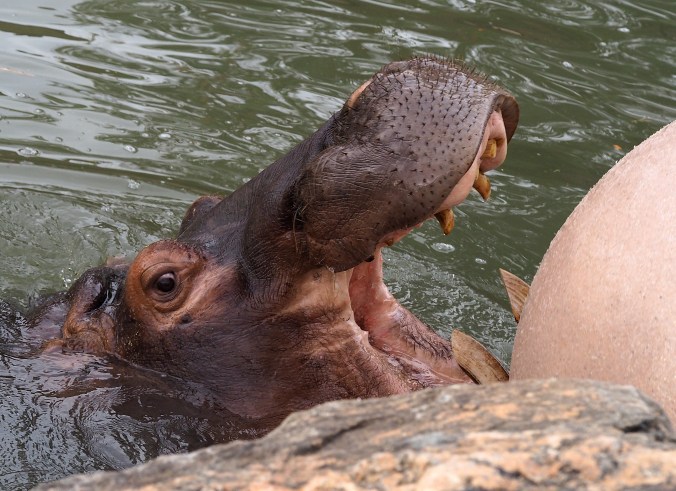
This hippopotamus wrestled her ball all around her little pond, trying to bite it (apparently). She’d go underwater for several seconds and then re-emerge to engage the ball again. As I think I mentioned a couple of posts ago, I have mixed feelings about zoos. I used to think they were important for conservation efforts and education, but I recently read a New Yorker article that rather convincingly refuted that argument. The obvious boredom of many of the animals, despite “enrichment” items such as balls and other toys, pains me. I don’t so much mind seeing fish or reptiles or amphibians in tanks (some photos of those later), but for mammals the Denver Zoo strikes me as a rather sad place.

I don’t actually know that this hippo is a female; I’m just guessing. Her/his teeth, especially those tusk-like lower canines, serve as a reminder that hippos are the most dangerous animal in sub-Saharan Africa (other than humans themselves) in terms of the number of people they kill. So I’ve read, anyway.


Vainglory ~

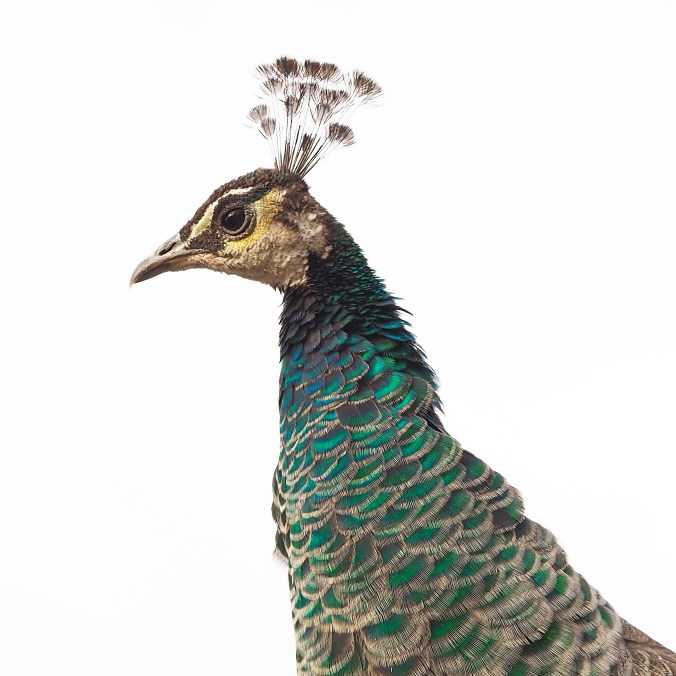
There is a photographer, Brad Wilson, who photographs wild animals in the studio against a plain backdrop. These peacocks (two of which are technically pea hens) were perched a few feet above me atop a brick wall. Since the day was overcast, the camera exposure rendered the sky almost white. So I decided to take it white all the way, crop the images, and turn them into portraits in the manner of Brad Wilson. To see some of his work, go to https://www.boredpanda.com/animal-photography-studio-brad-wilson/.

Get out of my face! ~

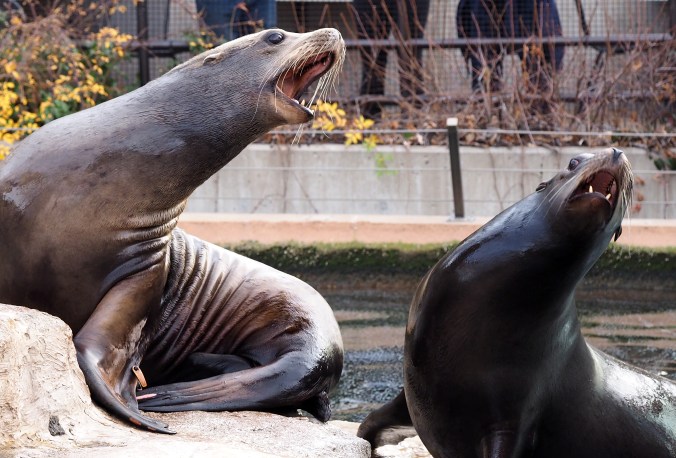
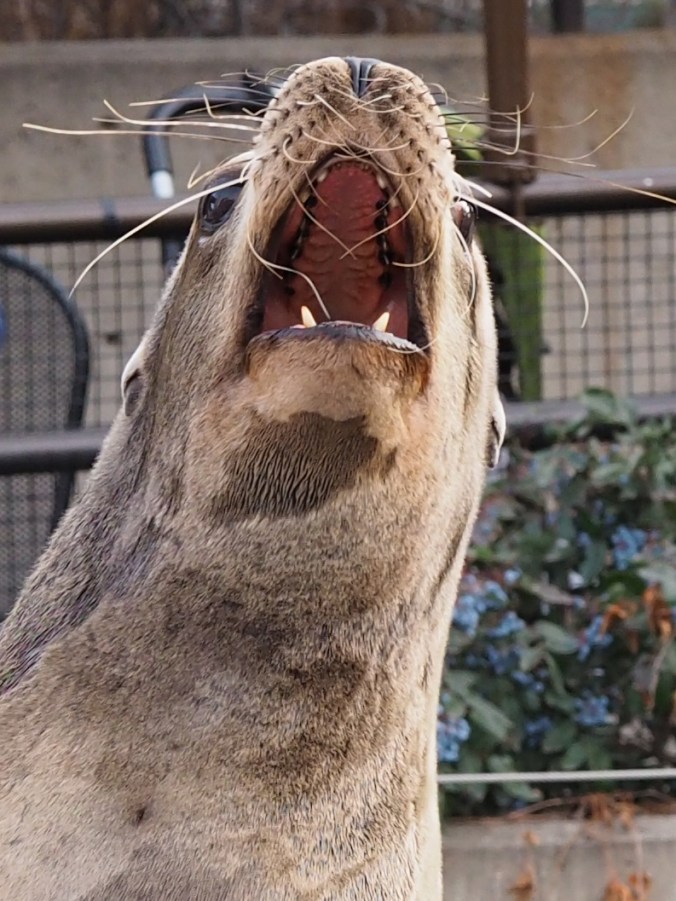
Yesterday I made my first solo foray into Denver. The temperature was in the mid-seventies and I wanted to give my 60 mm macro lens (35 mm equivalent = 120 mm) a thorough workout, so I headed to the zoo. First up: some sea lions who were having a serious disagreement.

Bugle boy ~

OLYMPUS DIGITAL CAMERA

I’ve finally heard an elk bugle, and it’s an impressive sound. This fellow in the Beaver Meadows section of Rocky Mountain National Park had a harem of five females and a youngster. Just before I took this photo, he bugled out a couple of announcements to other males that might be in the vicinity: Here I am, and I’m better than you are. Herds of elk also could be seen above the treeline across a great valley from the Alpine Visitors Center; from that distance they looked like dozens of little brown rocks, just dots on the landscape. Before long they’ll be thronging the streets of Estes Park.

Let sleeping cats lie ~

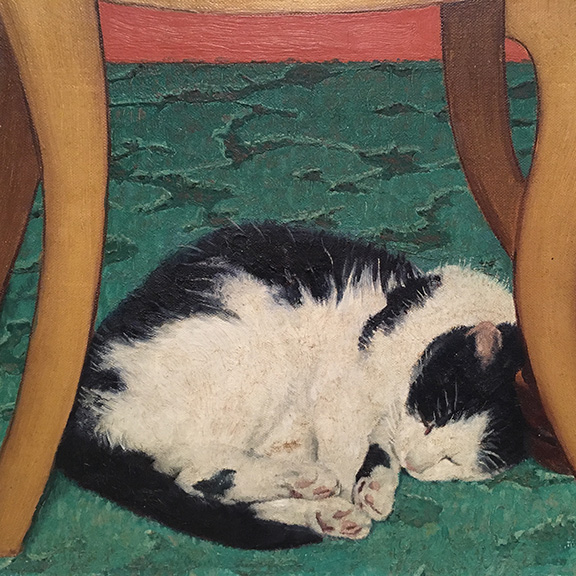
Rockwell-Facts-of-Life-detail-IMG_1629

Despite the recent elevation of Norman Rockwell’s reputation in the art world, he’s still not my cup of tea, and I still see him more as an illustrator (albeit a superb one). But there are definitely things to admire about his art. For example, in his painting “Facts of Life,” which shows a father telling his embarrassed son about the birds and the bees, he has included a sleeping cat (shown above) under the father’s chair, and kittens playing on the boy’s chair. It’s subtext par excellence: a sly way of directly depicting the very topic—sex and reproduction—that is being so earnestly discussed in the abstract. It also cleverly pairs the adults (man and cat) and the young’uns (boy and kittens): experience on one side of the painting; innocence on the other. The boy might well envy the kittens for not having to endure an explanation of what’s eventually coming (pun intended).

This work is in the collection of the University of Kansas’s Spencer Museum of Art. See the full version at https://www.wikiart.org/en/norman-rockwell/facts-of-life.

Crawfish, I guess ~

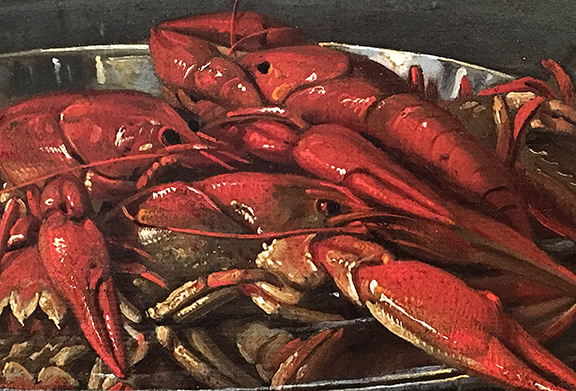
Monari-Still-Life-with-Dog-and-Fruit-IMG_1593

I’m going to return to museums for a few posts now. This is a small detail of a large painting by Cristoforo Monari (1667-1720) titled “Still-Life with Dog and Fruit.” Given the scale of various objects in the painting, I’m assuming these are some kind of crawfish rather than lobsters. (Someone more familiar with crustaceans will undoubtedly be able to set me right.) I must say, the one in the front looks rather fearsome. The work is in the collection of the University of Kansas’s Spencer Museum of Art.

Parakeet omelet ~

image

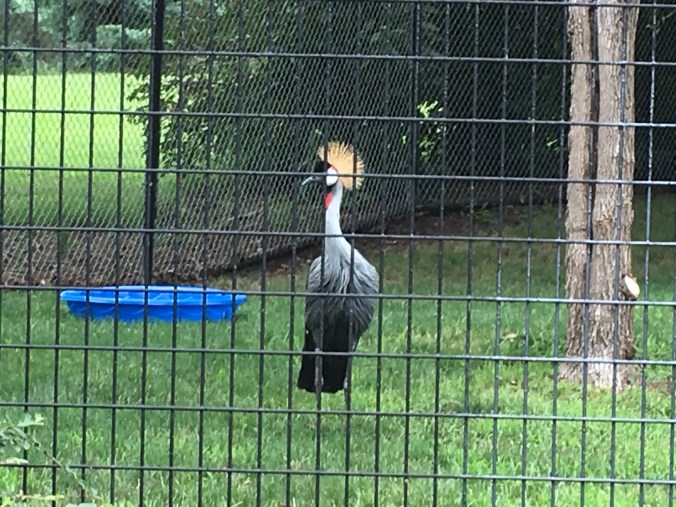
Crown crane

image

Snow leopard

image

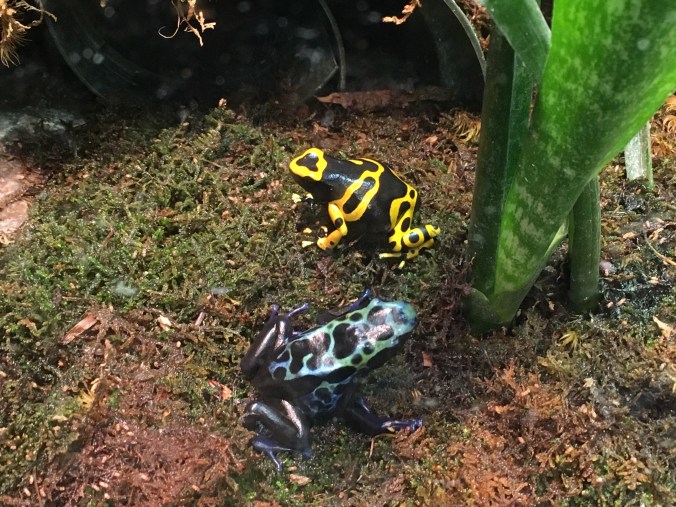
Dart poison frogs

image

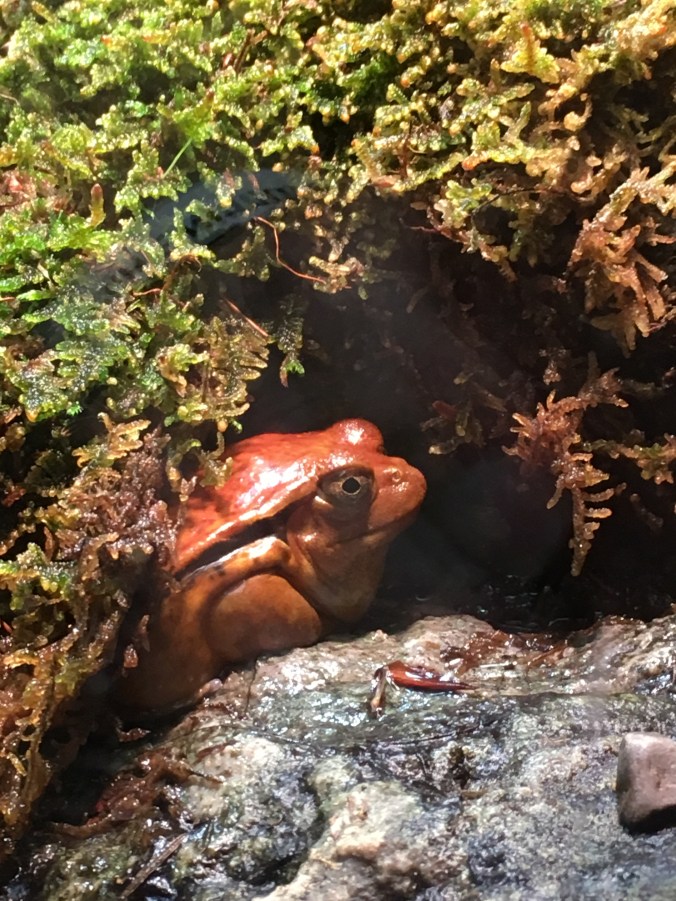
Tomato frog

image

Waxy monkey frog

Every time I’ve driven past Salina, Kansas, on I-70, I’ve taken note of billboards for Rolling Hills Zoo. Today I finally checked it out. It was mid-afternoon and hot, so most of the animals were napping in their dens or in the grass—barely discernible lumps of fur. After walking for awhile I got too hot, so I boarded the zoo tram at the next tram stop. I was the only passenger the whole way, so at every stop I talked to the young driver. He might have been 18. He might have been 16. He said he’d volunteered at the zoo for the past three years and this was the first year he was allowed to drive the tram. At our first stop he got off and stood by the tram looking at the giraffes in their enclosure and said thoughtfully, “I think this is the best place in the world.”

It is a beautiful place: gently rolling hills (the name is true) with trees everywhere and enclosures that allow the animals privacy if they don’t want to see humans. I told the boy that I was especially interested to see the crown crane, my favorite of the crane species. He said that it used to live in the giraffe enclosure and that he enjoyed just watching the things it would do. “It has a definite personality,” he said. “I notice that more about birds than mammals, maybe because I keep birds.”

Specifically, he keeps parakeets. “In the beginning I was hoping to breed them,” he said, “but you can’t tell the sex of a parakeet until it’s about a year old and it turned out I had all females.” Since they were laying unfertilized eggs, he once gathered about a dozen and made an omelet. “It was pretty small,” he said. He made a shape with his hands about the size of a little saucer. “They tasted just the same as chicken eggs, but instead of yellow they were almost transparent on the inside.”

This was a first for me, to meet someone who’d eaten a parakeet omelet. That alone was worth the stop. I wish now that I’d asked his name. He said his favorite part of working at the zoo was educating people about conservation, and that he hoped to go into conservation as a career.

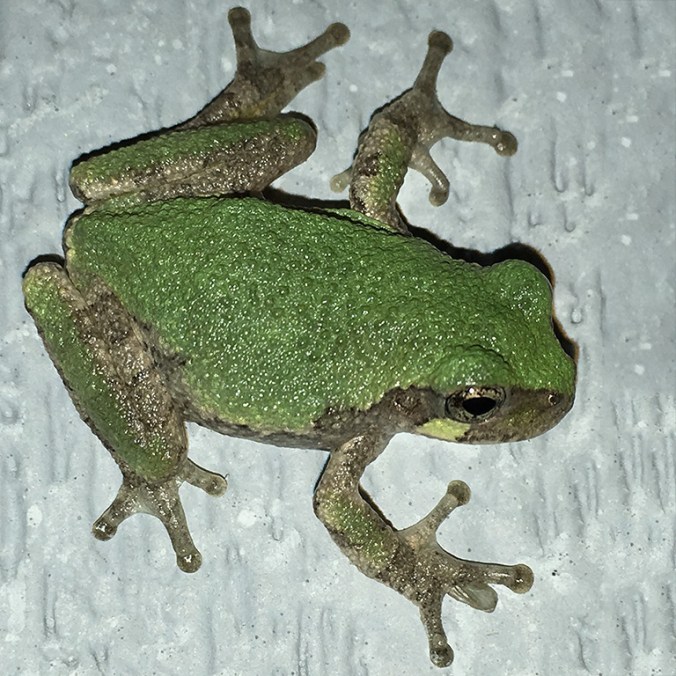
I left the tram at the Wildlife Museum that’s a part of the zoo. This place has spectacular dioramas, but I was most interested in a special exhibit of frogs and toads. A video was playing and I heard the words “Southern Illinois University researchers led by Karen Lips discovered that frogs in Central America were dying off from the chytrid fungus….” That’s not a verbatim quote, but it caught my attention. Years ago, as the editor of SIU’s research magazine, I had interviewed Karen and learned about the alarming disappearances of amphibian species around the world due to this fungus, coupled—scientists think—with environmental stressors that have made the species especially susceptible to it. Karen and her team had chanced to be in Costa Rica and Panama at the very time this die-off was happening, and documented the event.

The exhibit included a large lighted panel with photographs of frogs and a quote from a Paul Simon song that, coincidentally, I’d been singing along to in the car just the day before:

“There is a frog in South America
Whose venom is the cure
For all of the suffering
That mankind must endure.”

He was talking about the dart-poison frog, of course. The song, “Señorita With a Necklace of Tears,” is on the album “You’re the One.”