
And this is a copy of “The Blue Fox” (1911), by Franz Marc. Here’s another fabulous work by Marc: “Stables.” It’s at the Guggenheim in New York. I can’t even imagine how one goes about painting something so complex and gorgeous.
And this is a copy of “The Blue Fox” (1911), by Franz Marc. Here’s another fabulous work by Marc: “Stables.” It’s at the Guggenheim in New York. I can’t even imagine how one goes about painting something so complex and gorgeous.

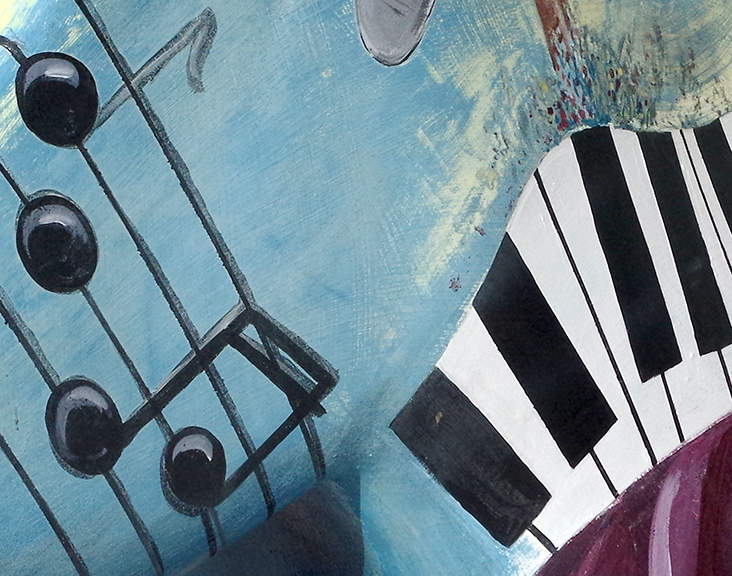
This is a copy of “Night blue fly” (1982) by Chinese-American artist Walasse Ting. I’m not sure where I acquired a postcard of this work. Upon looking for online images (there are some, under copyright), I was chagrined to see that I’d been holding the card upside-down. It works in both orientations, I think.
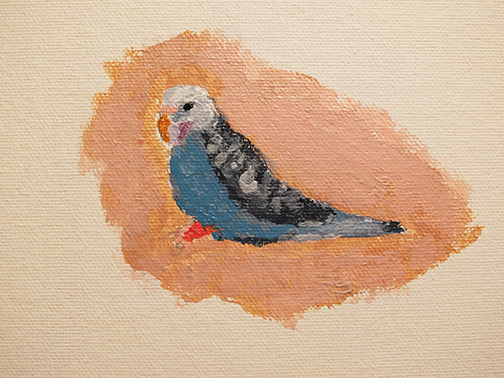
El perico

El perico – crop

Palette 2-11-16

The face in the paint
Since I’m also taking Spanish, I decided to use Spanish for the title of my little class painting today. The parakeet needs more work, but is, I think, at least identifiable as some kind of bird. But I’m feeling very excited about doing the close-ups. I needed something like this just now to get back to taking photographs. Can’t always be on a road trip. And I can do this no matter how cold or nasty it gets outside!

Abandoned building, west-central Kansas: a time-honored photo cliché
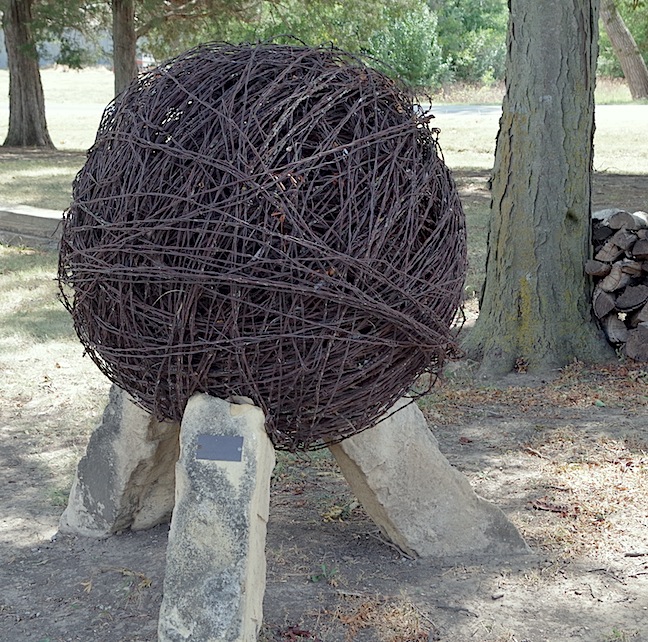
Ball of barbed wire, Kansas Barbed Wire Museum, LaCrosse, KS

Barbed wire splices, Kansas Barbed Wire Museum

My first helicopter ride. Hoisington, Kansas.
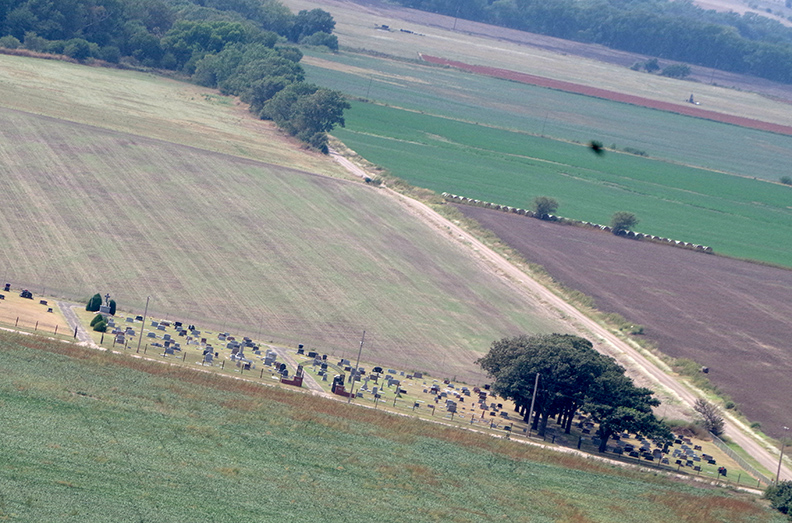
Helicopter view, Hoisington, Kansas.
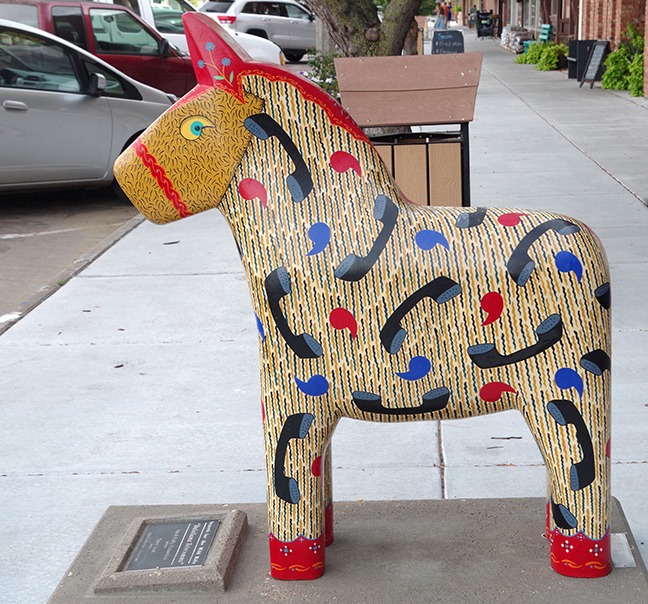
“Dalallama Telecomma,” dala horse painted by Steve Scott, Lindsborg, Kansas
Detail of “Hello Dala,” painted dala horse by Gretchen Elliott, Lindsborg, Kansas
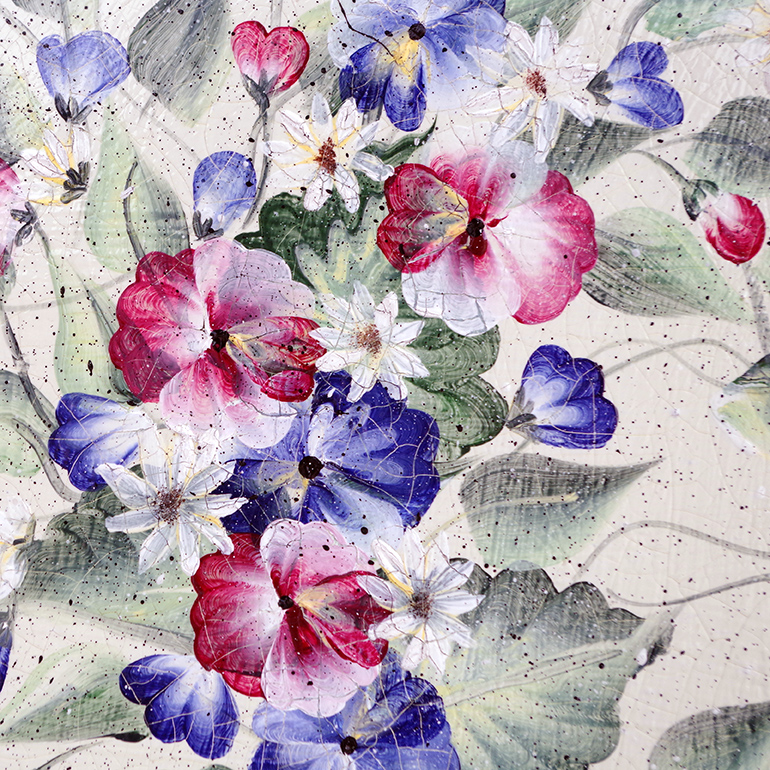
Detail of “Blossom,” painted dala horse by Jennifer Krob, Lindsborg, Kansas

Cultivated sunflowers east of Lindsborg, Kansas
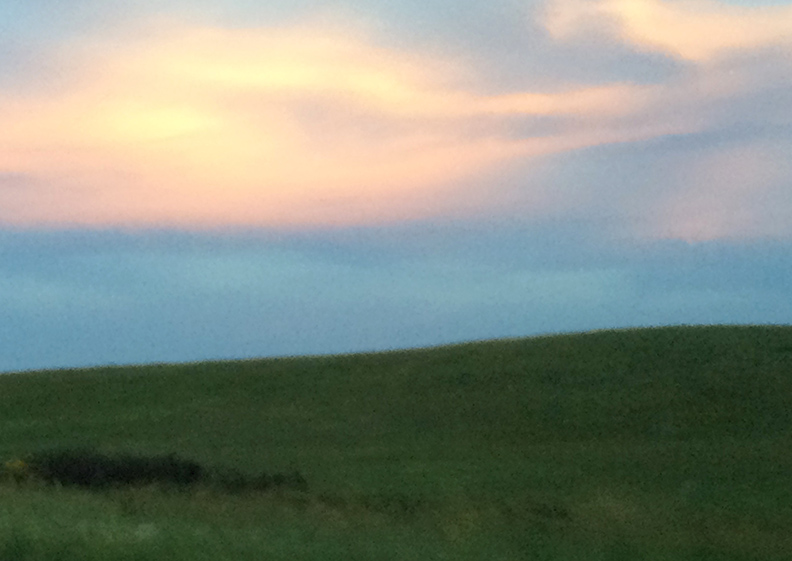
This through-the-windshield iPhone shot taken somewhere between Junction City and Lawrence, on the eastern edge of the Flint Hills, is so out of focus that it has an impressionistic quality.
Day 13: Colby to Lawrence.
My destination for today was Lawrence, Kansas. From there it would be a quick drive to Kansas City on Sunday. Knowing I had plenty of time, I took back roads much of the day.
My first stop was at an old favorite: the Kansas Barbed Wire Museum in LaCrosse, Kansas. It was my third visit (I’m not making this up). There was a time years ago, before my late husband and I stumbled upon this place, when I no doubt thought barbed wire was barbed wire was barbed wire. Ha! Not a chance of it, and this little museum, which is always deserted, will set you straight. It has hundreds upon hundreds of variations of barbed wire, plus the tools needed to string and tighten it, plus all sorts of auxiliary items. The director estimates that about 500 patents exist for different types of barbed wire. But each patent can cover hundreds of variations; the total is mind-boggling. One Glidden barbed wire patent covers some 2,400 variations, for example. Among my favorite exhibits at the museum are two barbed-wire tornadoes and a huge crow’s nest made of scraps of barbed wire.
Before leaving, I asked the director where I might get a sandwich to eat. He suggested the Dairy Queen in Hoisington, about 15 miles to the east. It was an inspired choice, because if I hadn’t stopped at the DQ and idly picked up a brochure on the counter, I’d never have known that Hoisington was having a Labor Day festival and that one of the activities was helicopter rides, 40 bucks per passenger.
While I ate my cheeseburger I mulled that over. I’d never flown in a helicopter before, or even been inside one. The prospect was scary, yet enticing. When would I get such a chance again? I could at least look. So when I was done at the DQ, I backtracked, drove through (or rather, around) Hoisington’s downtown, and found the helicopter site. The copter looked awfully small. The pilots said they couldn’t afford to take up just one passenger. Okay, I said, I’ll wait a couple of minutes and see if someone else shows up.
Meanwhile I asked a bunch of stalling questions: Do I weigh too much to go? (Not even close; they could take a 300-pound passenger!) Wasn’t it too windy to fly? (No, helicopters love the wind!) I had fallen a couple of days ago and my left leg was hurting; would I be able to pull myself into the helicopter? (They’d help me!) I sat in my car, still ambivalent. Then a black SUV pulled up: father, mother, son, daughter. The son was first out, and it soon became clear that he and his dad were going up. The pilots waved me over, and I found myself plunking down two 20-dollar bills. I and the boy, who looked to be about 10, would be seated in the back, where there were windows. The pilot (a woman! yes!) and the dad would take the front seats, where there were no doors. “I’m scared,” the boy said matter-of-factly, without any visible sign of anxiety. “I guarantee you I’m more scared than you are,” I told him unwisely. “It’s bumpy,” he said (we hadn’t left the ground, but it did feel bumpy with the engines on). “Should we hold hands?” I said. “I’m going to hold on here,” he said, grabbing the bar between the back of the front seats. I did the same. And then we were up and off!
We were all wearing headsets so that we could hear the pilot and each other. “This is awesome!” the kid yelled as we began to fly over Hoisington. I was with him one hundred percent. I believe I might even have added “Woo!!” I was taking pictures like crazy, and the kid and I kept announcing how fun it was. It was wonderful fun. It was even fun when the helicopter banked significantly, though I was grateful I had a window next to me and not an open door. The ride, which lasted only four minutes or so, was far too short. I wanted to keep flying. Heck, I was ready to take lessons. But Lawrence awaited. I waved goodbye to the family, who were in fact from Hoisington, and headed down the road to Lindsborg.
This Scandinavian town was new to me. I got there at 5 p.m., so most places were closed except for an exceptional fair-trade shop called Connected. But Lindsborg hosts a sidewalk herd of painted dala horses. Wikipedia: “A Dalecarlian horse or Dala horse is a traditional carved, painted wooden horse statuette originating in the Swedish province of Dalarna. In the old days the Dala horse was mostly used as a toy for children; in modern times it has become a symbol of Dalarna, as well as Sweden in general. Several different types of Dala horses are made, with distinguishing features common to the locality of the site where they are produced.” In Lindsborg, the paintings on the horses may reflect the business where a given horse is located, or the interests of the sponsors or artist. One thing I noted is that the dala horses, which are chunky creatures, have no tails. I enjoyed photographing details of the paintings.
And then, as I was leaving the vicinity of Lindsborg, serendipity struck. I finally found what I’d been looking for all over Kansas and eastern Colorado: sunflowers! A whole big field of sunflowers with their heads still up (though, oddly, not facing the sun but facing east). I did what I could with my Pentax and my not-so-long lens, trying to get the best photo I could for me and my sunflower-loving friend Dinah.
At Salina I rejoined I-70. The rest of the drive to Lawrence was tedious, but it seemed to me that, all in all, I’d had the best possible day on the Plains.

Streamside on Fall River cabin

Fall River, Estes Park. In Southern Illinois we would call this a creek.

Beaver Meadows, Rocky Mountain National Park

Rainbow Curve, Rocky Mountain National Park

chipmunk at Rainbow Curve

At Forest Canyon overlook, Rocky Mtn. Natl. Park
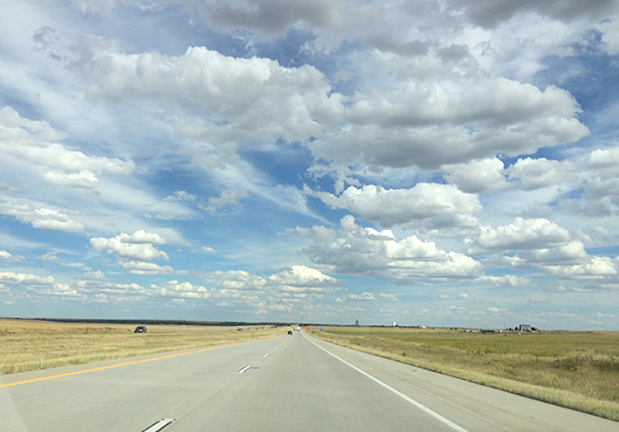
Heading home: eastern Colorado
Day 12: Estes Park to Colby.
Yesterday evening was the sort of evening that reminded me of the disadvantages of solo travel, and today was the sort of day that made me grateful I was traveling alone.
After splurging on a cabin (technically, I had one-third of the cabin) on Fall River just west of Estes Park, I went into town, had a bite to eat, and then tripped on a step I didn’t see. Down I went on the concrete on my palms and knees. The only thing I remember thinking, other than “I can’t stop myself,” was “How will I get home?” I was close enough to the café to call for help; two of the wait-staff brought me ice and got me to my feet. I found out that I could drive if I was careful. I got back to the cabin just in time to catch the manager, who was on her way out, and she kindly brought me more ice and towels. I spent the rest of the evening feeling thankful that I hadn’t broken any bones or hit my head, and that it seemed I’d be able to drive a longer distance than the three miles from the middle of Estes Park to the motel.
The next morning I headed, somewhat gingerly, for Rocky Mountain National Park. I intended to spend only an hour or so. I wanted to visit the place where my sister and I had scattered our parents’ ashes 12 years ago, but I wanted to leave early and drive as far home as I could, because my calculations had shown me that, once again, I was due to reach Kansas City on a Monday or Tuesday, precluding a return visit to the Nelson-Atkins Art Museum for the sixth consecutive time. So I determined to drive two long days and get to K.C. on Sunday.
In the park, however, I took a wrong turn and found myself heading up into the mountains on Trail Ridge Road. That’s okay, I thought, I’ll just go as far as Rainbow Curve (the second major overlook from the east), see how I handle the altitude, and turn around.
I handled it fine. It felt so good, in fact, and the weather was so cool and delightful, that I made an abrupt change of plan: I’d drive all the way across the park, come down to I-70 on the west side, stay the night somewhere, do things in Denver for a day or two, and stretch out my arrival in K.C. to Wednesday.
By this point in the trip I felt that my 10-year-old Prius and I were practically fused, a virtual woman/machine hybrid. We were at one with each other, it seemed. Until Rainbow Curve. Shortly after I pulled out of the overlook, the car began laboring badly. I nursed it along, hoping it would shake off whatever the problem was. No such luck. At Forest Canyon overlook, 11,700 feet above sea level, I decided to turn around, get the Prius back down to Estes Park, and see if I needed to find a mechanic.
In town I got lunch at a place I’d noticed called “You Need Pie!” Yes, I did: that was truth in advertising. The car had no pie but seemed to be doing better nonetheless, so I headed toward Denver, a route that descends from about 7,500 feet to about 5.000. And soon the car was running normally again. I reverted to my original travel plan: drive like hell toward Kansas City. The car and I ended up in Colby, Kansas, together, reconciled, and back in our own time zone.
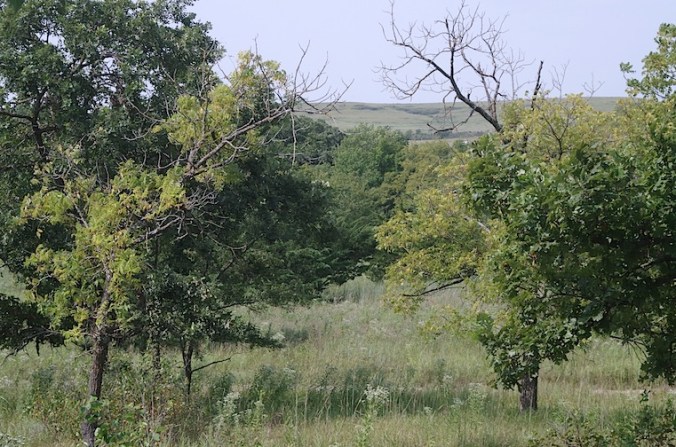
Konza Prairie

Grasses closeup, Konza Prairie
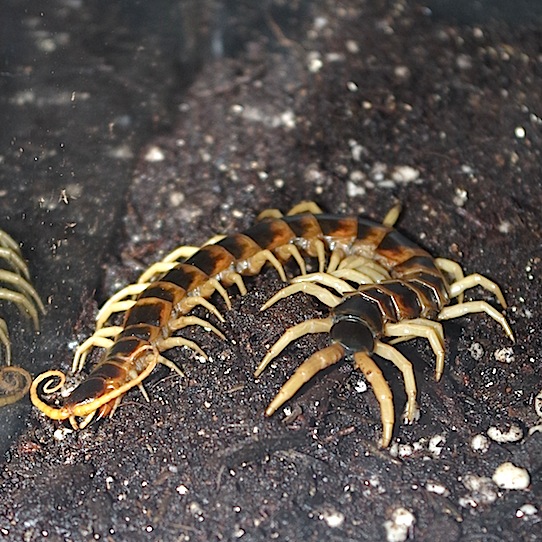
Giant Sonoran Centipede

Giant Wingless Walkingsticks. There are at least seven walkingsticks in this photo.

Giant Wingless Walkingsticks. Although this photo is mostly out of focus, I’m including it to show how much the insect can bend its body. These two look like they’re doing a ballet.
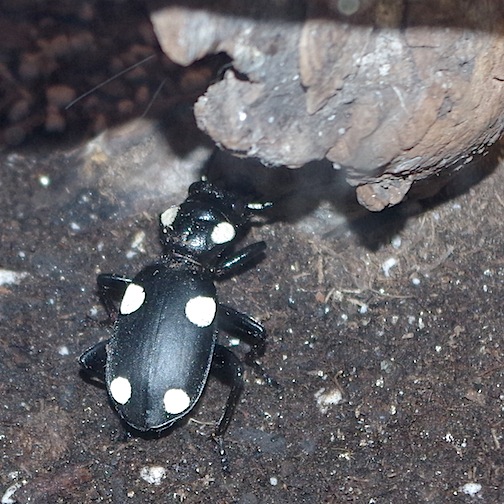
Indian Domino Beetle

Pumpkin Patch Tarantula
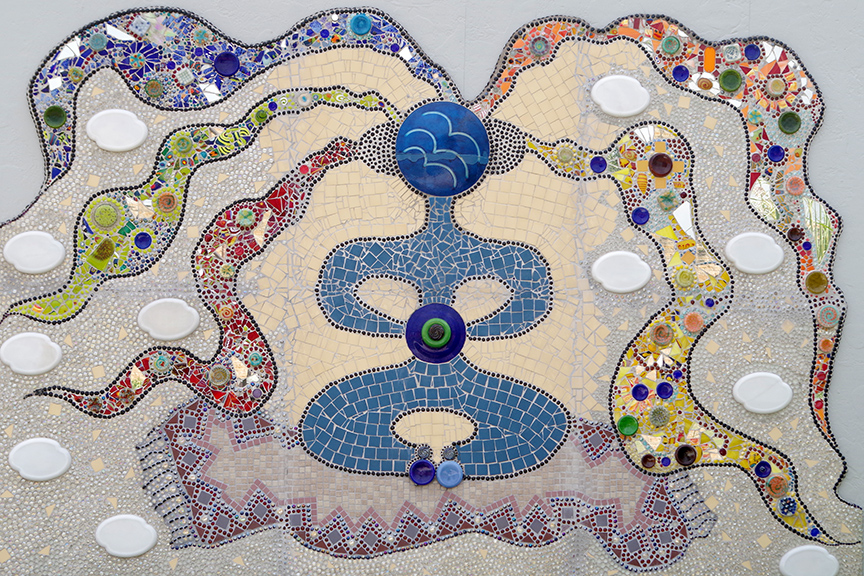
Bowl Plaza mosaic, Lucas, KS
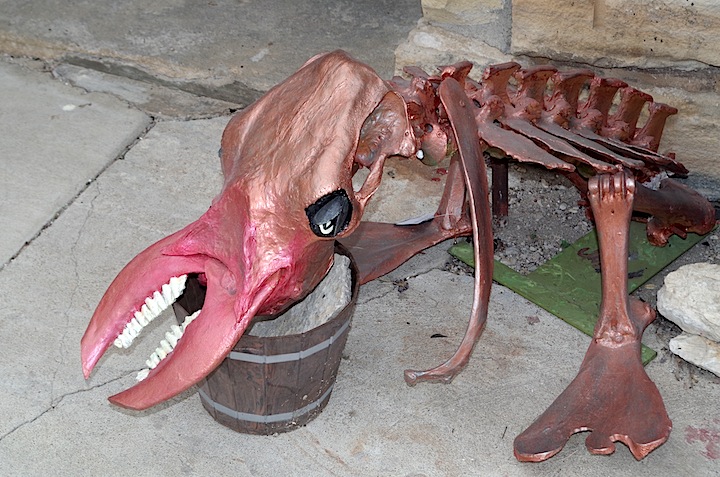
Courtyard sculpture, Grassroots Art Center, Lucas, KS

Courtyard sculpture, Grassroots Art Center, Lucas, KS
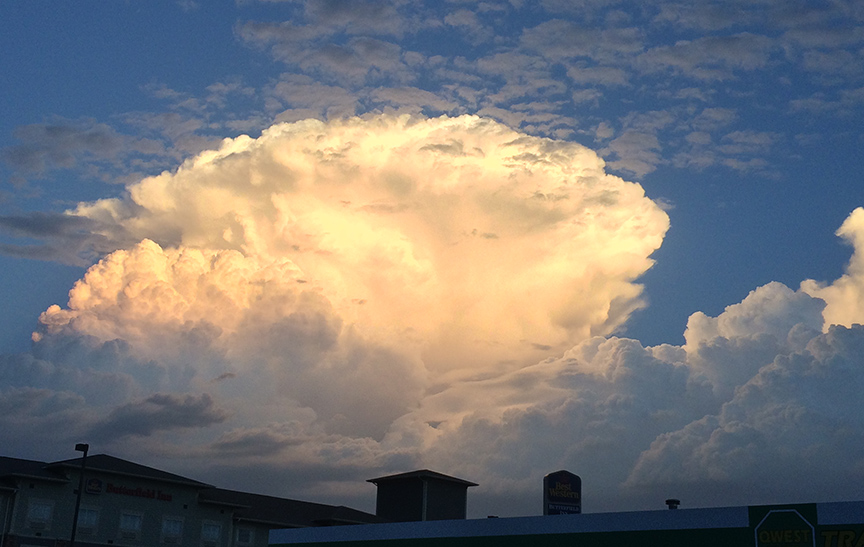
Cloud lit by sunset, Hays, KS
Day 4: Lawrence to Hays.
My hair has been whipped into a Medusa-like appearance thanks to the high winds here in western-central Kansas. Tonight I’m staying in Hays, and although one thunderstorm developed behind me as I was heading west, more storms are expected. I’m used to Kansas being windy, but this is unusual, and high-wind advisories have been issued.
I left Lawrence at 8:30 a.m. and got on the tollway headed for Topeka. The land opened up to the sky and I began to feel I could breathe freely. This landscape suits me much more than the landscape along I-70 in Missouri, which feels overgrown with trees and stifling. I hightailed it to Manhattan and the Konza Prairie. For years, on trips to see my parents in Broomfield, Colo., Steve and I noted the big sign along I-70 that announces the Konza Prairie. But I didn’t know much about it until I interviewed SIU plant biologist David Gibson, some of whose research involved prairie restoration out at Konza. This is a Nature Conservancy site administered in cooperation with Kansas State University. I walked for about half an hour along the main nature trail. It wasn’t far enough to get to the true prairie section, but it was peaceful and pleasant. Thinking of nature reminds me of how loud the cicadas were in Lawrence, even in heavily commercial areas, whereas here in Hays there are some kind of screaming, squabbling birds. I’m not sure what they are; they look something like crows, but their heads are differently shaped and they splay their tails.
After that short spell at Konza, I headed for KSU’s insect zoo, which specializes in tarantulas, walking sticks, katydids, cockroaches, and scorpions (the latter I passed by; reading “The Pearl” did it for me and scorpions, which I despise). Now that I think about it, more than half of the critters residing in the insect zoo are not insects at all. They’re other types of arthropods—arachnids (tarantulas and scorpions) and myriapods (centipedes and millipedes). (In confirming this online, I discovered two odd facts: Because all centipedes have an odd number of pairs of legs, no centipede species has 100 legs. Furthermore, no known species of millipede has 1,000 legs. So neither type lives up to its name. I feel compelled also to quote this from the Wikipedia article on centipedes: Even nonvenomous centipedes are considered frightening by humans due to their dozens of legs moving at the same time and their tendency to dart swiftly out of the darkness towards one’s feet. A 19th-century Tibetan poet warned his fellow Buddhists that “if you enjoy frightening others, you will be reborn as a centipede.”)
Lunch was a turkey sandwich with cranberry relish at the Bluestem Bistro, and a couple of chocolate-covered pretzels at Cold Stone Creamery. Then I headed out of town, intending to take a secondary road all the way past Salina to Lucas. But K18 was detoured onto I-70 because of road construction, and a good thing too. If I’d taken it, I never would have gotten to Lucas in time to make a quick tour of the Grassroots Arts Center. This quirky little museum preserves and displays outsider art (the more common term than grassroots art, and a better one, I think, for these self-taught artists truly are outside the mainstream, and their art often takes the form of large outdoor assemblages).
The docent told me that the museum is in Lucas because four such artists had lived and worked there. The museum tries to track and save outsider art installations across the country; too often, upon the artist’s death, these pieces, which are typically made of unconventional materials, are discarded. Two of my favorite pieces at the museum were full-size replicas of a car and a motorcycle made of thousands of aluminum pull-tabs from soda cans. Not for nothing is the artist, Herman Divers, described as “the master of pull-tab construction.”
I took many photos here and also at the town’s Bowl Plaza, which is the entrance to their public restrooms. (“Bowl” refers to exactly what you might think.) The mosaics in the plaza are made from pieces of colored bottles, bits of old porcelain plates, and other miscellaneous objects. The restrooms themselves also have mosaics; they’re supposed to be gorgeous and are actually listed in the AAA tour guide as among the state’s attractions. That sounded laughable until I saw the beauty of the outdoor mosaics. I wonder if these are the only restrooms in the United States so honored. Unfortunately, they were closed for repairs when I was there. But I hope to return to Lucas on the way back home.
This region of Kansas is called Post Oak Country due to the use of quarried rock posts instead of wood for fenceposts. The interstate from roughly Manhattan to Wilson also is paralleled by hundreds of wind turbines. As I drove a back road up toward K18 and Lucas, these gradually petered out. In a couple of places an old-fashioned windmill to bring up water for stock tanks was juxtaposed against the landscape of turbines. The drive from Lucas back to I-70 winds through sculpted bare hills reminiscent of some of Georgia O’Keefe’s paintings, though in a different palette. Trees line the creeks and cluster in hollows; at Konza Prairie I learned that these are called gallery forests.
Then the road curves around the east end of Wilson Lake, which had whitecaps today from the wind. To the east the land drops off from the road into a huge valley; to the west is the lake. There are two or three parks and wildlife areas here that I’d like to check out on the way back. The light from the hazy sky—today has been very hazy, I suppose from the high winds picking up dust from the gravel roads—gleamed off the lake. (Note: The haze, which persisted to the Rockies, turned out to be pollution from the wildfires in the West Coast states.)
I stopped in Wilson, “the Czech capital of Kansas” with “the world’s largest painted Czech egg,” for supper, a piece of pecan pie. I didn’t have to go out of my way to drive by The Egg, which was propped up on a corner lot with what looked like makeshift, rusty metal braces. The world’s largest painted Czech egg should have a better setting than a weedy lot, it seems to me. Say, a corner-lot-sized park with some flower beds. That would be a big improvement.
Then it was down the road to Hays, with clouds and sun ahead of me and dark thunderclouds behind me. My legs and feet are sore from driving and walking. Road-trip fatigue has set in early, since I’m toting a ridiculous amount of stuff into the motel each night, even while leaving things in the car. That’s the biggest disadvantage of a solo road trip. Well, aside from the mixed-up jumble the suitcase becomes as dirty clothes mingle with clean clothes. And not knowing the good places to eat. And road construction. And the driving itself. But otherwise, I love road trips!

Part of neon sign collection, American Jazz Museum, Kansas City. The Fox’s Tap Room sign is original.
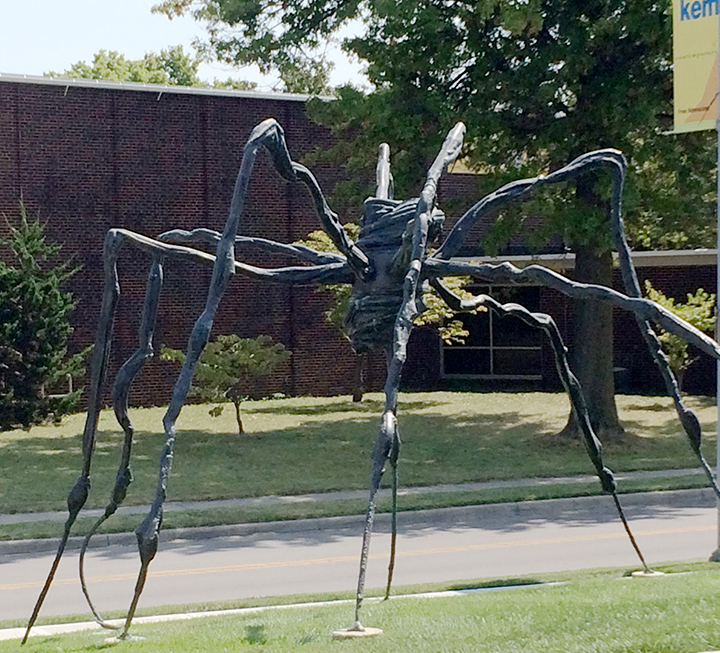
“Spider,” by Louise Bourgeois, 1996. Permanent collection of the Kemper Museum of Contemporary Art. This sculpture has been adopted as the museum’s logo.

Detail of “Bacchus,” by Helen Frankenthaler, 2002. Permanent collection of the Kemper Museum of Contemporary Art.
Days 2 & 3: Boonville to Lawrence.
Yesterday morning I left the Boonville Comfort Inn before 10:30, ready to face the “major delay” promised at mile marker 77. There turned out to be no delay, so I ended up parking outside the American Jazz Museum in Kansas City a little before noon. This is in the 18th & Vine district, where Charlie Parker came to prominence, so I listened to some of Parker’s music while I was driving to K.C. to put me in the right mood. (For those who haven’t seen it, “Bird,” starring Forest Whitaker as Parker and directed by Clint Eastwood, who is a jazz aficionado, is excellent; see what Roger Ebert had to say about it here). The museum was small but had lots of listening stations. I wandered around looking at the exhibits and listening to some classic jazz. The place was deserted. I would like to also have seen the Negro Leagues Baseball Museum, which is on the other side of the same building, but my legs needed a break and my stomach needed lunch.
I decided to look for a lunch place while en route to the Kemper Museum of Contemporary Art, which had been a disappointment when David and I visited in 2012. Why the Kemper? Because the Nelson-Atkins Art Museum is closed on Mondays and Tuesdays, and I always seem to be going through Kansas City on Monday or Tuesday. Argghh!
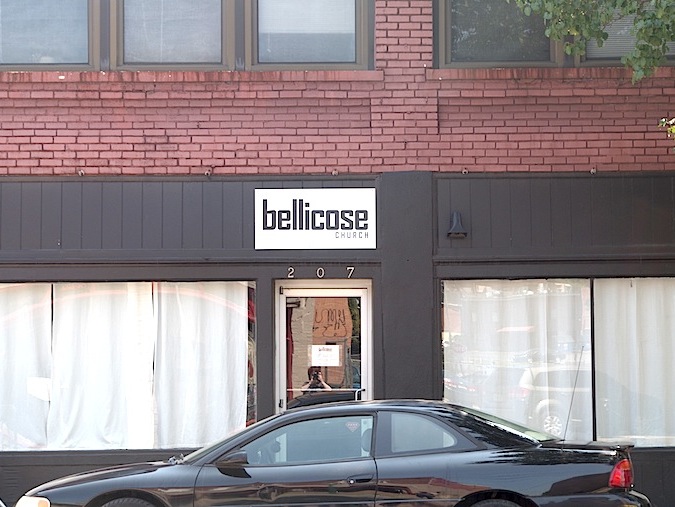
On the way a no-left-turn sign diverted me from my route and I found myself in a couple of gentrifying blocks. I photographed the sign for Bellicose Church, on the assumption that it was indeed some sort of place of worship and not, say, the design studio of someone who’d given himself a peculiar name. The typography was uncommonly good for a small church, or for pretty much any church. But I thought it was funny, whatever it was. (I just now looked it up and no longer find it funny. It is a church—a “missional community”—with this action statement: “We named our church Bellicose because we don’t believe that Jesus wants his church to be passive. Therefore we’re inclined or eager to fight for people’s hearts (John 15:13), aggressively hostile to the gates of hell (Matt 16:18, Matt 11:12), and warlike against sin (1 Pet 2:11, 2 Cor 10:3-5) — we’re aggressive in our love for God and people.” Well, at least they’re honest about it. But God save me from people who are aggressive in their love for God. So is ISIS.
After photographing the church facade, I went into, and back out of, a place called the Corner Café. I am indeed a total rube when it comes to food. I’m reluctant to try anything with ingredients that I need to have defined or that seem bizarre. For instance, one salad came with espresso vinaigrette, which seemed to be overreaching for originality. Every lunch entreé involved one or more such oddities, so I after I visited the Kemper Museum I sat in my car in the parking lot eating the string cheese, carrots, and almonds I’d packed, which was much cheaper and probably more healthful.
I spent very little time at the Kemper, which was again a disappointment because the main building has only a couple of small galleries devoted to their permanent collection. However, included in those galleries was an absolutely wonderful purple painting by Helen Frankenthaler called, appropriately, “Bacchus.” It alone was worth the visit. I took some photos, none of which begin to do it justice. Then I fell for a ceramic vase in the gift shop, which is precisely what happened the first time I went to the Kemper. Don’t go in museum gift shops when you’re tired and hungry: That should be one of my mantras. There is a vacation phenomenon whereby you give yourself permission to spend money on such things even though you tell yourself not to. And here I’ve been getting rid of as much stuff as possible at home.
I decided not to take the turnpike to Lawrence, but to go the southern route, through Overland Park. Once I got off 470 and onto Kansas Route 10, it seemed like I was in Lawrence in no time. I found the main drag easily, ate cheese ravioli and spanakopita at a Greek/Italian restaurant, then hit the nature store and the toy store that I’d spotted on my first drive-through. Oddly, given that I’d just mentioned Mexican jumping beans in my recent blog post on spirit animals, the nature store had some of those little clear boxes of beans on the checkout counter–the first I’d seen in years. The sales clerk, an older woman, knew about the larva, and about why they jumped. Some of the beans were in sunlight, and they did seem to be jumping more than the ones that were in shadow. “Here,” she said, handing me a section of newspaper. “If you put that over the display, they’ll stop jumping.” I did it, and bingo, the jumping stopped immediately. That was impressive. I did it a couple more times and told her about my blog post. I bought a 50-cent plastic lizard as a mascot for the trip and also an inexpensive but lovely fossil, an orthoceras–an ancient cephalopod that navigated by squirting water out of its body. The toy store, which was jaw-droppingly extensive, made me wish I knew someone with a little kid. It would have been great fun to explore the whole place and buy tons of presents.
This morning, in my motel room in Lawrence, I decided that I needed extra sleep before going to the Spencer Museum of Art, my main reason for stopping here. I ended up sleeping all day. In the evening I called the museum, which the AAA Tour Guide said was open until 8 p.m. on Wednesdays, and a recording announced that it was closed for renovations until sometime in 2016. So that was that.
I’d forgotten that when I sleep in the daytime, my dreams tend to be more nightmarish than usual. Now I’m feeling very bad emotionally, with my legs aching from driving, and I’m beginning to think about aborting the trip. The drive out seems overwhelming, and the drive back, impossible. Given everything I’ve learned about Fort Collins real estate in the last two weeks, it seems a fool’s errand to go out there. I’m also worried about my sister back in Carbondale, who has descended from hypomania back into depression, and I feel guilty about leaving the dogs in the kennel for so long. I’ve decided to put off the decision until tomorrow morning. I showered after getting up at 5:30 tonight, so tomorrow I can just get dressed, throw everything into the car, and take off. Whether west or homeward, I don’t know.
A few weeks ago I watched an Internet video of a sloth crossing a road with agonizing, preternatural slowness, and it suddenly hit me: The sloth is my spirit animal.
I conceived of it as a Steven-Wright–type joke:
“I found out that the sloth is my spirit animal, but I’ve been kinda slow telling people.”
This seemed hilarious to me, although only a couple of people on my Facebook page seemed to appreciate it. But the incident got me to thinking about the whole issue of spirit animals, which certainly seems to fall into the category of cultural appropriation by Caucasian New Agers of a Native American concept. But that’s a matter for anthropologists or activists.
What interests me is that only certain animals seem to be candidates for spirit animals. You never hear anyone claim the echidna as her spirit animal, for example. I can imagine the reaction these would get in a standup comedy routine:
“My spirit animal is a naked mole rat.”
“A platypus.”
“A turkey vulture.”
“A grub.”
No, it’s always a beautiful or strong or otherwise majestic mammal or bird. Eagles. Horses. Bears. Lions. Perhaps some inventive person somewhere has tabbed the Luna moth or the chameleon, but if so, I haven’t heard about it.
And after all, what would be wrong with an amphibian or reptile, an insect or crustacean? They have admirable qualities. Couldn’t your spirit animal be a jellyfish or a brittle sea star? How about a sea cucumber? The octopus is an extremely intelligent creature for an invertebrate; I’d be honored to have an octopus as my spirit animal.
It just isn’t done.
It subsequently occurred to me that, in my case at least, one spirit animal is not enough to cover the territory. I can’t deny that I have sloth-like tendencies. But on other occasions my spirit animal seems to be the little larva inside a Mexican jumping bean that makes the jumping bean jump (a purposeful thing: it’s trying to move the bean to a cooler place; but it looks erratic). Other times, my spirit animal seems to be a termite colony. I figure it can’t be a termite, singular, because a single termite can’t really do squat; the colony acts like one huge Borg-like organism. So when I’m working hard and my brain is brimming with activity, my spirit animal is the termite colony. I seldom have days any more when I feel pretty, but if I did, on that day my spirit animal would be a leafy sea dragon.
When you think about it, all sorts of possibilities seem plausible. This could be a new party game: What spirit animal fits a given celebrity? Donald Trump’s spirit animal is the crocodile, I think, and Mike Huckabee’s appears to be some type of pit viper. The Kardashians (and I still don’t really understand who they are, nor do I wish to) collectively seem to be a horde of mosquitoes, constantly whining away on the media.
So much potential unexplored! The concept of a spirit animal, I think, has a lot of life left in it.
Note: This is a very long post, but for me it is a necessary tribute and a necessary corollary to an earlier post. A handful of Facebook friends will have read parts of this essay on the FB memorial page I set up for Steve.
In my post Into the Confessional I talked about the death of my second husband from alcoholism and my responsibility for his death. But “alcoholic” carries such profoundly negative connotations that it obscures the person who suffers from the disease. I would hate for anyone to think “Steve = alcoholic.” He was smart, funny, creative, nice—and a true original who had more peccadillos than an armadillo (one of our favorite animals). I’ve never known anyone like him.
Steve was the type of person who always stopped for road-crossing turtles and moved them where they were going, no matter how much peril this entailed for our own car. He loved animals, all animals. In his last few years he became a vegetarian, a choice that perplexed his parents and took them about three years to accept. He had a multi-volume animal encyclopedia that he often browsed through, and he’d frequently show me a picture of something like a naked mole rat or a fennec and insist, “I need one!” I liked the animals he showed me too, but I had to tell him no, which made him pout.
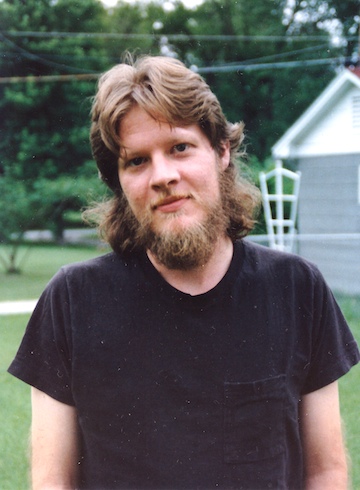
Steve, age 32
In the early 1980s Steve co-managed a used-record store in St. Louis and then one here in Carbondale. He was an expert on rock, jazz, and avant-garde classical music in particular. As a young man, he worked for a time as a janitor; with a St. Louis friend, he recorded three albums under the name The Janitors. He came to believe that Bach’s cantatas were the most sublime music ever written, but he also loved the Beatles with almost equal passion.
Most people seemed to recognize right away that Steve was a good-hearted person. Here was one act of generosity: Once when he was at the vet’s with our dog Sammy, a young client discovered she had no money to pay her bill. Steve offered to cover the charges. Our vet didn’t let him, but she often speaks of that gesture. On the other hand, Steve was capable of crimes against humanity, or at least music browsers. He was fond of telling me about the time at the St. Louis record store when he played Yoko Ono’s screechiest LP at top volume for 12 hours straight. Apparently not too many people browsed the bins on that day. It’s a wonder the store stayed in business, but it did well with Steve in charge.
Taken together, these two anecdotes epitomize the fact that Steve was a paradox. He was kind to people, yet he generally didn’t give a damn what anyone else thought about his actions. Nor did he mind making people feel uncomfortable or even driving them temporarily insane. In music, he had a tremendous capacity for loudness, dissonance, and the avant-garde. In his personal life, it was just the opposite. The modern world was too “noisy” for him—too many aggravations, impediments, hassles, and impositions for him to easily endure. He frequently said that he was born a few centuries too late.
He could never have been married to a normal, talkative, high-energy person. Whenever I became somewhat animated or enthusiastic in conversation, he accused me of “fizzing and popping.” I’m not sure if I ever pointed out that many of his LPs consisted largely of fizzing and popping, but he knew there were certain ones that he could play at top volume only when I was out of the house. These LPs stressed me out, but Steve enjoyed them and I think they helped him cope with stress.
Steve also used The Weather Channel as a calming agent—this in the days before the endless sensationalistic series it now favors. Often The Weather Channel was on at our house for hours, yet neither of us ever seemed to know the forecast. One morning we blearily watched the “Local on the 8s,” then looked at each other and said in unison, “Did you catch that?”
Steve was not materialistic. He bought used books and used records and little else. Eventually he did start amassing a CD collection, which burgeoned when he began an endeavor to Acquire Every Bach Cantata Ever Recorded (more than 200 are extant). He meticulously kept track of this project on sheets of graph paper. After his death I kept the papers, but let most of the CDs go. The sheer number—more than 80—was just too overwhelming to deal with in the midst of the hundreds of other CDs, LPs, and tapes he owned.
Steve liked the fact that he was born on the same date that Shakespeare was (probably) born. April 23 also is World Book Day, which seems appropriate. Steve loved books. He used to buy arcane, ratty old paperbacks—nonfiction, usually on history, philosophy, or art—for a quarter or so at the library book sales. If he spent more than a quarter, you knew it was something that he really wanted. Kurt Vonnegut was the major exception to this thriftiness. Steve would spring for a hardback when a new Vonnegut book came out, if I hadn’t already given it to him for a present.
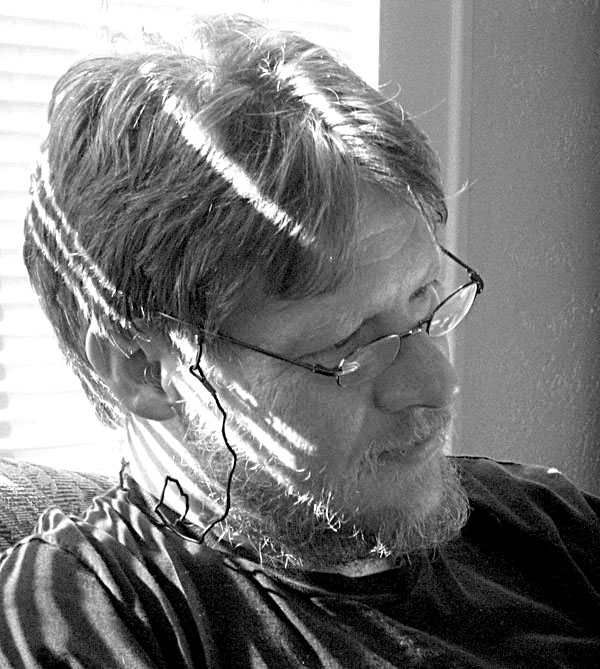
Steve, age 48
Some other people and things that Steve liked: Bertrand Russell, Douglas Adams, Monty Python, Star Trek, Nick Drake, Eric Dolphy, Brian Eno, Kraftwerk, Jan Garbarek, Glenn Gould, chopped garlic slathered on thin-crust pizza, Sriracha Rooster hot sauce, desert boots (remember those?), black T-shirts, Asian paintings, African sculpture and masks, found objects used as art objects (I’ve kept a small green sewer lid he found before we were married), “Barney Miller,” “The Andy Griffith Show” (and its theme song, which he recorded onto a tape loop), Woody Allen, independent and foreign films, really bad movies (he called these “Liberty” movies, after the decrepit Liberty Theater in a nearby town, which showed mostly really bad movies for a dollar admission), “High Plains Drifter,” Sophia Loren, Heath Bar Blizzards, pocket watches instead of wristwatches, minimalism in almost every area of life, porches, trees (he couldn’t bear to see a tree cut down), and National Geographic, especially the maps they sometimes included.
A born nature lover, Steve had his happiest times during high school and college when he and his friend Perry hiked all over southeast Missouri and southern Illinois. Certainly Steve and I had our best days during vacation trips. I loved showing him places that were close to my heart from family vacations, but even better was traveling where neither of us had been before—like Craters of the Moon National Park, in Idaho, or New Hampshire’s Kancamagus Scenic Highway in the fall. Steve’s favorite states were Maine and New Mexico, along with the Upper Peninsula of Michigan. The remoteness was part of their appeal, I think. Had we ever made it to Alaska, I’m not sure I would have gotten him back to southern Illinois.
Fully half of Steve’s utterances to me came from other sources. Many of his favorite expressions were used by a subset of guys his age who were smart, deeply weird, and lovers of Monty Python and early Saturday Night Live. Some expressions were Steve’s own, and some I never have found sources for. Whenever I’m talking with someone, Steve-isms constantly fly out of my mouth, as if I’m channeling him. Here are just a few of the things that I heard a lot:
One original expression of Steve’s that I found hilarious was the time he referred to dog food as “proto-poop.” (Perhaps you had to be there.) Another time our neighborhood association was discussing the party noise coming from a rental house and Steve said to a friend of ours, “Maybe we could burn a boogie deck on their front lawn.” That still makes me laugh.
A quotation often directed at me was “Are you talking Pig Latin? What do all of those words mean?” (from the Dilbert cartoon in which Dogbert is answering the phone at a call center). Any number of circumstances could trigger that one. A saying that I came up with myself (to the best of my knowledge) was “I don’t have to talk to you and I don’t have to not talk to you.” Steve adopted this one immediately and later attempted to claim authorship of it. He was also very much into saying that he was going to copyright the word “the” so that he’d be rich and wouldn’t have to work anymore.
I miss all of this nonsense tremendously. Steve kept his private thoughts just that—private—so to a large extent these and a hundred other like expressions WERE Steve for me.
Academically, Steve was a psychology and philosophy double-major, and he was a special fan of Greek philosophy. This nearly crippled our marriage. One of the most exasperating things about Steve was that I couldn’t get him to discuss problems or to work through fights. Such “conversations” quickly derailed, with Steve heading one way, making intense, incomprehensible statements about Plato, while I headed another, usually trying to persuade him that he needed to take more initiative about things.
Steve’s tragedy was that he didn’t know what to do with his life. He could have been almost anything he wanted to be. Instead, as a master’s student, he racked up what probably still stands as the highest number of incompletes in the history of SIU’s philosophy department. So he worked as a secretary (a high-stress job, as anyone who’s ever been a secretary knows). When he hyperventilated on the way home from work one day, I suggested that he take a year off work and paint, which is what he really liked to do.
He knew a great deal about art, and though few people saw his work, he was an excellent painter of abstract compositions. So he quit work, painted a great deal, and eventually submitted some slides to a top Chicago gallery. Unfortunately, this was equivalent to a writer shooting for publication in The New Yorker right off the bat. He was rejected, but the gallery owner wrote him a note saying that he found the paintings interesting and to let him know if Steve was going to be showing his work in the Chicago area.
This outcome was kind of like winning second prize in the lottery: not what you’d hoped for, but pretty damn good. I knew this from my days of sending out poetry manuscripts to little journals (not The New Yorker), and I told Steve he had netted quite a compliment. But Steve never sent slides to a gallery again. When I began entering photographs in juried art shows in the region, I encouraged him to do the same. You need to build up a résumé to approach major galleries, I told him. No dice. Rejection, I think, just felt too risky to Steve, and it was easy for him to get his back up—especially when he knew his work was good.
And it was good. I still have two big Hollinger boxes full of Steve’s paintings (his medium was undiluted watercolor on paper). His parents took what I call the Rorschach approach to abstract art. Confronted with one of Steve’s paintings, they complimented it but would try their hardest to find something in it that resembled a real-world scene or object. In her mid-70s, Steve’s mom took a watercolor class and quickly showed a lot of talent at representational painting. So a few years after Steve and his dad died (both in 2008), I hauled the Hollinger boxes down to her and let her choose any paintings she wanted to keep. She may not like abstract art very much, but on some level she gets it. Damned if she didn’t pick some of the very best ones.

Steve, age 49
A much better cook than I was, Steve made great omelets and an excellent chunky marinara sauce with green peppers, mushrooms, and onions. But some things eluded him. He made several attempts at homemade pizza, but the crust never came out right. One Christmas his parents gave him a bread machine, which led to a couple of near-disasters, which led to the giving-away of the bread machine. And as many times as he tried, his homemade hummus never tasted like the kind in restaurants. But most of what he made was delicious.
Steve was less attentive to his appearance than just about anyone I’ve ever met. When his parents expressed their disapproval (“Why don’t you take some pride in how you look?”), he reminded them of what the Bible had to say about pride. (He was an atheist, but couldn’t bring himself to tell his Southern Baptist parents.) Steve felt he was unattractive—I never could convince him otherwise—and I think he just trained himself not to care. In the profile picture I posted on his Facebook memorial page (see above), his beard is neatly trimmed, but in the early years of our marriage it was long, skimpy, and scraggly, so that he looked a bit like an underfed Scots-Amish farmer.
The profile picture also shows Steve’s beloved hemp hat. He found these hats at the Neighborhood Co-op, and I bought one too. He loved this hat so much, he would have slept in it if he could have. He wore his winter and summer, outdoors and indoors, day and night, virtually 24/7, for years, until the sweat stains made it look as if he’d spit tobacco juice over the whole thing. Then holes developed where the brim attached. Finally even I couldn’t stand it, and I gave him my own hat, which I seldom used (too warm). He wore it sometimes but frequently reverted back to the Hat From Hell. The hat made Steve instantly recognizable on campus and in Carbondale generally.
On the rare occasions nowadays when I see a tall, thin guy wearing a similar kind of hat, my heart stops momentarily. I’m thinking it always will.
 VAPOR AND FLOW