Some things I never thought I’d say ~

All teenagers, however precocious, are shortsighted. It can’t be helped. As a teenager, I never would have thought I’d say any of these things.

  1. “I’ll have the broccoli.”
    (I’m not sure I ever saw broccoli until I left home. My mother never acknowledged its existence, or that of most other vegetables. I’m still confident I will never eat turnips, beets, rutabagas, chard, or many other healthful things. That goes double for kale, the celebrity vegetable du jour.)
  2. “I’m here to get my ears pierced.”
    (When I was in my mid-30s, two friends of mine finally dragged me to the mall to undergo this rite of passage. Convinced that it would hurt like hell, I’d never worked up the courage on my own.)
  3. “Okay, I’ll sing in the recital.”
    (I have terrible performance anxiety. In high school I had two mandatory piano recitals. Knowing I’d play worse if my parents were there, I banned them from attending either one.)
  4. “Let’s go ahead and color my hair.”
    (My parents derided women who tried to disguise their age by coloring their hair. Of course, that was before women of all ages, not to mention teenagers, began coloring their hair just for fun. When you don’t have much to feel good about physically, it’s a real boost to know that most people guess you’re at least 10 years younger than you really are. I’ll take it.)
  5. “Is a biopsy really necessary? It isn’t cancer.”
    (For years and years, before I began taking antianxiety medication, I was convinced that “it,” whatever it might be at the moment, was cancer. Unless it was heart disease.)
  6. “I do.”
    (I was adamant that I would never marry, although I wanted a lifelong relationship. I figured my soulmate and I would just live together. So why, when I was semi-proposed to, did I say okay, without any meaningful reflection whatsoever? Simple: I was still a teenager.)

Celosia ~

Celosia

Celosia

Still getting acquainted with my new Fuji. I liked the curving stems of these Celosia (cockscomb) flowers outside a local restaurant. I’ve been optimizing photos for this blog using PC instead of Macintosh settings so that the photos won’t appear too dark. I wonder if most bloggers use PCs or if they disproportionately use Macs. Any bloggers have any idea?

Into the confessional ~

Caveat: I’m abandoning my principles in making this post. There is nothing humorous here at all, and the few readers I have might usefully be advised to skip it. This post is principally for me to get the refrain of the past six years set down in writing. My friends have heard this ad nauseam, and they’re tired of hearing it. They needn’t read this. They’ve told me I’m not to blame, but I reject that judgment. One can’t absolve oneself of a great wrong because it is emotionally convenient. It doesn’t work that way.

____________________________________________________
Some say the world will end in fire,

Some say in ice…
—Robert Frost

There was more than one nightmare on Elm Street. I lived on the street by that name in our town for 15 years, and the experience was bracketed at either end by deaths. One I had nothing to do with. The other I caused. There were accomplices, including the victim, but I dealt the killing blow.

The night before my second husband and I closed on the first and only house we bought together, a young man—a kid, really—raced his car up our portion of Elm Street, lost control, briefly went airborne, and struck the big sweet-gum tree in what would soon be our front yard. He died on the spot.

That’s what we learned when we arrived at the house the next day for the last walk-through before closing. The police had been so thorough in removing signs of the wreck that it took a moment to realize something very bad had happened. Tire tracks cut across the neighbor’s yard and her flower bed and disappeared into our front yard. On this balmy spring day, thousands of small pieces of glass glinted like ice over the lawn. An elderly woman from the apartment building next door told us what had happened the previous night. “If that tree hadn’t been there,” she said more than once, “I would have been killed in my bedroom.”

I felt sick for the boy and sick about this ominous development. Although my rationalism rejects superstition, my emotional side remains vulnerable. We’d looked a long time for a house, but now I wasn’t sure I wanted this one. I’d been afraid of death most of my life and I didn’t need my own front lawn serving as a perpetual memento mori. Everything seemed marred and wrong. I was prepared to forgo the earnest money and walk away, but when I brought up this possibility, the real estate agent said dismissively, “Well, it’s not as if someone killed himself in the house. I could see that bothering a person.”

We signed. Not having witnessed the accident made it easier to put out of mind. Still, I often thought about it when I looked out the living room windows. Fifteen years later, we were still picking up stray pieces of glass from the front lawn.

In my mind, that boy’s life ended in ice. My husband’s ended in fire.

We had a rocky marriage. I didn’t realize it until almost the end, but he was an alcoholic, and I fear that certain problems of my own caused his alcoholism to become worse. He lied about his drinking, as alcoholics do, and the lying was what really bothered me. Steve—I can write his first name instead of using initials, because what I write can’t hurt him now—wasn’t a mean drunk. Most of the time I didn’t even realize he was drunk. He went to bed early and I went to bed late. I didn’t know he was drinking in the mornings. I didn’t know he went home at lunch so that he could drink; he said it was to walk the dogs. I didn’t know much of anything. After his DUI he stopped drinking at the bars but found creative ways to hide his drinking at home.

Three times I told him if he lied again about drinking, I’d leave. Three times I went back on my word.

The fourth time I said I was leaving, I pushed Steve to call C., a friend of his who had gone through hell and successfully quit drinking with the help of AA. After the conversation he came into the living room, sat by me and cried and said I’d been right about calling C. The next morning he went to work drunk, clung to his boss and told her she was his family now, and was suspended for three weeks.

He begged me not to leave. I knew he probably wouldn’t make it without me; he had no friends in town and was completely emotionally reliant on me. Still, I bought another house and I went to San Diego to move my disabled sister back to live with me—both decisions proving to be additional disasters in the making.

Meanwhile, Steve was reassigned to another job, which he lost after a little more than a week. This time there was no appeal, although I met with the university authorities and did my best to advocate for him. My sister lived with us for two months while I had repairs done to the new house. In retrospect I can’t believe I was cruel enough to subject Steve to that, and even to ask him for help in doing things.

At some point shortly after he lost his job there came a morning when I couldn’t wake Steve up. He was barely conscious. After my sister and I followed the ambulance to the hospital, I realized I hadn’t brought his wallet. When I returned home I went into the basement, Steve’s locus of operations. All of his pill bottles stood empty, along with an empty whiskey bottle. I estimated that he’d taken 200 pills of various types. He hadn’t left a note. He was unconscious for three days and in the hospital for nine. Only then did I really start trying to help him, but it was too little too late. Why not earlier? I don’t know the answer to that question. To say that I was stupid and naive seems insufficient.

The insurance company refused to fund an inpatient rehab program, saying that Steve needed to have failed at an outpatient program first. On his first day at an outpatient program, such a violent fight broke out between two participants that the police had to be called. Terribly frightened, Steve had an accident—he only told me this much later—and never returned to the program.

Not long after that I drove him five hours to an inpatient program that said they had an open bed. When we got there, however, the bed had been taken and the program had been told that insurance wouldn’t cover Steve’s stay anyway. I argued with the insurance company; the program argued with the insurance company. Nothing.

I scheduled him with a self-pay inpatient program locally, but the program required that the patient call to confirm that he’d attend. He never called. Two months later I tried again. He never called.

The day before Thanksgiving, he told me he needed help. After several hours at the local ER, a hospital two hours away accepted him into short-term rehab. Nobody mentioned an ambulance. I drove him up there in darkness; by the time we arrived he was vomiting. The day after Thanksgiving he called to say he was being released. Less than 48 hours in detox? I made the drive again. He said he would never go back to a locked ward. They had confiscated his belt, without which his jeans wouldn’t stay up, and his shoelaces, without which his shoes wouldn’t stay on. He was afraid of the other people on the ward. The next time he had to detox, he refused to go to the ER, so I persuaded him to detox at my house. All I knew to do for him was to make sure he kept drinking water. I had already begun suggesting that he move in with me and my sister, but he refused.

I proceeded with a divorce. The lawyer had said that assets from my parents’ estate, which were earmarked for my sister, could be jeopardized if Steve had a DUI and killed somebody. Much later I found out this was almost certainly untrue. Steve wanted to put off signing the papers, but I wouldn’t let him. When he finished signing, he gave me a look of rebuke and hatred. I deserved that.

I took him to doctor’s appointments, the ones he didn’t cancel or refuse to go to. Once you try to kill yourself, we discovered, many helpful medications are off-limits. Nothing allayed his anxiety. Finally his psychiatrist put him on Seroquel. I thought he was sleeping so much and missing AA meetings because he was drinking. He was, but he also was knocked out by Seroquel. One morning he called at 4 a.m., thinking it was afternoon.

I went to Al-Anon meetings, which I found useless. I called complete strangers from these meetings and blurted out every sordid detail of my behavior and his problem, but there was no consolation. Steve was dying in front of me. It was like watching a disaster unfold in slow motion. C. flew in from the East Coast to see if he could help Steve. When I called him later, he was pessimistic. Steve wouldn’t talk to him seriously, he said. Steve was in denial.

Filled with anxiety, I lay on my couch or in my bed day after day and tried to get warm. My bones were cold, a feeling I’d never experienced before, and I couldn’t stop shaking. Nor could I get to work very often. The roof, which I’d had inspected before I bought the house, leaked every time it rained. Then came a major ice storm, which caused a tree limb to drop straight through the roof and attic and impale itself in the ceiling of my spare bedroom. The sun came out then, blindingly, glaring off all the ice-covered surfaces.

When the end came, it was on a day we had argued. Two days later the coroner called me at work, at my ex-father-in-law’s request. Alerted by neighbors, the police had broken into the house on Elm Street and found Steve’s body. It wasn’t hard for them to reconstruct what had happened. Steve had run out of matches and tried to light a cigarette from the stove burner. When the fire caught, it caught him too—alcohol was on his shirt and his beard. He inhaled fire. The police said he could not have suffered more than a couple of seconds. They were soft-pedaling it for me, I believe. Steve had time to stagger into the dining room, grope at a chair, and overturn it as he fell. There were burn marks on the floor. There were burn marks on the buffet. His pocket watch, which the police retrieved, was burned; his wallet was not. At the hospital we weren’t allowed to see his body.

I knew I might be killing him by leaving him, and I left anyway. I didn’t have to do it. There was nothing I had to save myself from. My guilt and grief threw me into a severe depression that eventually forced my retirement and caused physical debilitation. It’s something I’m struggling to fight my way back from. Steve exasperated me with his unwillingness to converse or to plan for the future, yet I have missed him greatly over the past years. He will never leave me. One of the few things I’ve learned in life is that the people you’ve loved never do leave you entirely, even as you go on to love others.

The last time I saw Steve was at our local grocery store. He was wearing his ratty old suede jacket. I threw my arms around him and began crying. His face was impassive. As far as I can remember, he didn’t say a word.

The hole in my heart ~

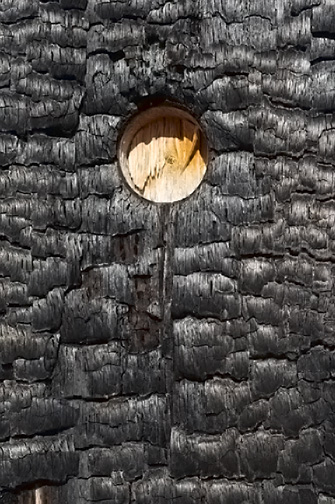
Burned Post

Burned Post

After I began this blog, I resolved not to write serious personal posts unless I could do it at least partially through the prism of humor. I also resolved not to be overly confessional, because that leads to bathos, boredom, and broken friendships.

But nothing seems amusing right now, and I’m no longer writing. Give it more time? Break my word? End the blog? I don’t like any of the choices.

When Chief Joseph had to abandon the fight to save his people, he said “My heart is sick and sad.” It sounds like a metaphor. It isn’t.

I don’t like the bottom half of my face ~

Self-Portrait via iPod

I took this terribly bad photo with a friend’s iPod Touch. My own iPod Touch must be a generation earlier, because I had no idea any iPod included a camera, however awful a camera it might be.

I haven’t yet noticed any bloggers posting self-portraits, so I may be violating some unspoken protocol here. Still, I liked this photo because it reveals the one part of my body I don’t mind seeing, and it also shows what has been my natural habitat over the past few years.

As for what to do about the bottom half of my face (much less the rest of my body)—well, I’m still mulling that over.

Bursting bubbles ~

It does seem to be true, at least in my case, that pride goeth before a fall, although one could predict that due to probability alone. For the past two days I’ve been congratulating myself on learning a new skill: giving subcutaneous injections. Last Friday a nurse came to my sister’s house to give her the first of five injections of an insanely expensive drug that may reduce inflammation, thereby increasing her mobility. (Heartfelt thanks to the Chronic Disease Fund, which paid the $2,000 for 5 milliliters of this medication.)

The remaining four injections would be my responsibility to do, so the nurse walked me through all the steps, which were more numerous than I’d anticipated. Warm the refrigerated vial between your palms for three minutes. Disinfect the rubber top of the vial with an alcohol wipe. Attach an 18-gauge needle to the syringe. (The smaller the number, the bigger the needle, I learned—just like camera apertures.)

Draw back the plunger to the 1 milliliter mark to fill the syringe with air. Twist the protective cap off of the needle. Push the syringe into the vial. Push the plunger to force out the air. Upend the vial and, making sure the tip of the needle is submerged within the liquid, draw back the plunger to the 1 mL mark. (Yes, this is a long and boring explanation, but it’s necessary to the point of the post. Pun intended.)

Then comes the tough part: checking for bubbles. Tiny bubbles are okay, but anything bigger should be dealt with by flicking your finger against the syringe repeatedly until the bubble slides toward the business end of the syringe. Push the plunger a bit to ease the bubble up through the needle. Draw the plunger back down to 1mL and repeat. This process turned out to be both tricky and tedious: there is an area at the end of the syringe where there’s some plastic threading, and it always looks empty, as if there’s a bubble there. Often, though, it’s just an optical illusion.

When you’re satisfied that no substantial bubbles remain, remove the needle from the vial. Put the protective cap back on the needle and twist it off the syringe. Replace it with a smaller gauge needle and take off its protective cap. (These seem to resist removal.) Make sure a tiny droplet of medicine shows at the end of the needle, supposedly indicating there’s no air in the syringe.

Then swab your victim’s thigh (in this case) with an alcohol wipe, pinch a goodly bit of her flesh between thumb and forefinger, and make the stick. The needle should go almost all the way in, but not quite. Turn loose of her flesh and pull the plunger back slightly to make sure no blood enters the syringe, which would indicate that you’ve hit a vein. If everything looks good, inject the liquid, remove the syringe, and slap on a bit of gauze.

Simple, right? The nurse allowed me to do everything except the one thing she could not, because of some financial rule or other, allow me to do: make the stick. Naturally, this was the part of the procedure that scared me the most. As I poised the needle above C.’s thigh on Saturday, I hoped fervently that I would not spear her and produce a bloody mess. I steeled myself to hear howling, and I made the stick. No sound from C. The needle might have gone all the way in, which was wrong, but it turned out beautifully.

I injected the medication, pulled out the needle, and marveled that at first I couldn’t even see where the injection had been. A dot of blood much smaller than a pinhead soon showed itself. No bigger than the nurse’s had been! I did an abbreviated victory dance while C. pressed gauze on the spot, and then a completely unnecessary Band-aid went on. Woohoo!

Things went equally well on Sunday—except that I remembered just after I gave C. the injection that I’d forgotten to pull back the plunger to check for blood. But chance saved me: there was again just a teensy dot showing where the needle had gone in. I was pretty good at this, hey? I could be a sub-Q shot giver, were there such a job. What competence!

Then today rolled around. I drew the medication into the syringe and there appeared to be no major bubbles. This seemed suspiciously lucky, so I flicked my finger against the syringe a few times and tried to determine if a bubble was lurking at the hard-to-see end. After some fiddling around with the plunger, I finally decided that there wasn’t. I switched needles. In the process of struggling to remove the thinner needle’s protective cap, however, I realized that I didn’t have 1mL in the syringe. I had closer to 0.9 mL. The nurse had specifically told me this was NOT okay.

Crap! What to do? With considerable misgivings I decided to switch the needles again and draw more medicine out of the vial. I was pretty sure the nurse would have told me not to do this, but I couldn’t think of an alternative. I also didn’t see how anything would be contaminated, since the first needle had gone back into its protective cap. After making certain I had 1mL, I checked for bubbles again. Flicked again. Switched the needles again and ascertained that a droplet of medicine clung to the tip.

I remembered this time, after making the stick, to check for blood. There wasn’t any. To my consternation, however, when I drew the plunger back slightly, a large, sinister-looking bubble appeared at the needle end and slowly made its way up the syringe.

OH CRAP. OH CRAP.

I had quizzed the nurse extensively about this entire bubble subject, because it worried me so much. “What if I miss a big bubble and inject it into her?” I asked. “Am I going to kill her?”

Undoubtedly the nurse was laughing on the inside, but she kept a straight face. “No,” she said, “but the shot will be more painful. It’s if you have an air bubble inside a vein. Now that’ll get you.”

Frozen in place with the needle in C.’s thigh, I reasoned that since there had been no blood, I could not have hit a vein. I warned C. that this shot might hurt—the others hadn’t—and I pushed down on the plunger. There was a bigger spot of blood this time when I removed the needle, but no spurting—in fact, no Carrie-type scene of any kind. C. hadn’t made a sound.

“Did that hurt?” I asked her anxiously.

“Not really,” she said.

“I don’t think I killed you,” I said with relief.

“Oh well,” she replied. I almost expected her to add, “Nobody’s perfect.”

One more injection to go. Then I should be done with wielding needles for awhile. Maybe forever, if I’m lucky. And if anybody asks me about the experience, I’ll say modestly, “I did reasonably well. We both lived.”

Addendum: After the final injection, I had to revise this post because I still had a step wrong. Perhaps this is why I never taught Technical Writing.

The closest I get to wildlife photography ~

Wolf Spider

Wolf Spider

I found this beauty outside my local Kohl’s store. It was dark, but I had parked under a light near one of those little shrubbery-covered islands with the curb around them. (What are those things called, anyway? Shrubbery islands, I guess.)

I wanted to photograph the spider because two friends of mine had, a few months ago, found such a spider in their house, had captured it and photographed it as well as they could through a Ziploc bag, and had posted the photos on their respective Facebook pages with a plea for information. (It was revealing of their personalities that one of my friends wrote “THIS IS THE BIGGEST FUCKING SPIDER I HAVE EVER SEEN” on her Facebook page while the other one simply but eloquently wrote “This thing. What???”) I was pretty sure theirs was a wolf spider, and I knew this one was.*

For once, I had my camera bag in the car. The wolf spider was near my car door, so I wanted to proceed cautiously. Wolf spiders can move pretty damn fast. They can’t jump, but something in the limbic area of my brain persists in believing that they can. Besides, darting doesn’t differ much from jumping, if a large spider is darting in your general direction. To assess the situation, I tapped my foot on the curb a safe distance away. The spider stayed put. I then made an awkward kicking motion (which I hope no one saw) toward the spider, and it still stayed put. So I edged the quarter near it for scale.

Since the spider remained motionless—either dying or depressed, I figured—I got braver with my shots. Finally I put the camera on super macro mode, which required putting the lens scarily close to the spider. But I was emboldened by its apparent indifference. I recently bought a little Fuji X10, a very capable retro-looking point-and-shoot with a bright lens and lots of controls, and that’s what I used here. The image needed a little lightening and a little sharpening, and I cropped it.

It’s fortunate for me that I prefer abstracts and semi-abstracts for my “serious” photography work. Several of my friends excel at wildlife photography, and I admire their work greatly. I don’t have the patience to do it myself, however. I hate using tripods, and my weak hands don’t like dealing with the weight of long lenses either. But those are mostly excuses; I simply lack the talent for photographing wildlife, just as I lack the talent for leading a wild life. This is as close as I get on both counts, and it’s good enough for me.

* Wrong again! I have now seen a much better picture of my friends’ arachnid, and it was in fact an orb weaver. They have assured me that it was much bigger and much scarier than my wolf spider. B. swears it was as big as her face. This seems hard to credit, but okay. It’s also possible that one’s perception of spider size is at least slightly influenced by whether said spider is outside where it belongs or inside one’s house.

Failures of a book evangelist ~

At book sales and thrift shops I sometimes collar complete strangers who are perusing a book I’ve admired and urge them to buy it. Although this degree of enthusiasm doesn’t seem to have endeared me to anyone, I can’t seem to stop—encouraged, possibly, by the fact that no one yet has told me flat-out to shut up. Sometimes someone will talk to me, briefly; often people just sort of nod and edge away. As a confirmed book evangelist, I should perhaps add snake handling and talking in tongues to my efforts, because I’ve made only one convert to date. That is, on only one occasion have I known someone to read a book I’ve recommended. It’s #2 below, and my friend liked it very much, so at least I’m 1-0.

Since blogs seem an ideal platform for both evangelism and didacticism, and since the well of inspiration has run dry in other areas, I thought I’d push…um, recommend…a couple of dozen novels or short story collections published since 1980 that I can’t imagine anyone not admiring. How arrogant, eh? But I love these books. I LOVE THESE BOOKS and I want to share them with others, even JUST ONE PERSON. Most of these authors are well known, but some of the picks I’ve made haven’t gotten the attention they deserve.

  1. The Risk Pool, Richard Russo
  2. The History of Love, Nicole Krauss
  3. Housekeeping, Marilynne Robinson
  4. The Blind Assassin, Margaret Atwood
  5. Juliet, Naked, Nick Hornby
  6. Charms for the Easy Life, Kaye Gibbons
  7. Lighthousekeeping, Jeanette Winterson
  8. Postcards, Annie Proulx
  9. The Miracle Life of Edgar Mint, Brady Udall
  10. Hateship, Friendship, Courtship, Loveship, Marriage: Stories, Alice Munro
  11. The Gold-Bug Variations, Richard Powers
  12. Kafka on the Shore, Haruki Murakami
  13. A History of the World in 10 1/2 Chapters, Julian Barnes
  14. Illumination Night, Alice Hoffman
  15. Jazz, Toni Morrison
  16. Collected Stories, T.C. Boyle
  17. Moo, Jane Smiley
  18. The Lacuna, Barbara Kingsolver
  19. Apologizing to Dogs, Joe Coomer
  20. Felicia’s Journey, William Trevor
  21. I Was Amelia Earhart, Jane Mendelsohn
  22. Bel Canto, Ann Patchett
  23. Skippy Dies, Paul Murray
  24. The Mezzanine, Nicholson Baker

As long as I’m pushing, here are four more excellent books from this period that, amazingly enough, were made into excellent movies that stayed true to the source.

  1. The Remains of the Day, Kazuo Ishiguro
  2. The English Patient, Michael Ondaatje
  3. The Shipping News, Annie Proulx
  4. The Hours, Michael Cunningham

(I haven’t yet seen Life of Pi, but given the reviews I’ve read, it should be on this list as well.)

Because I’m the daughter of a champion list-maker, I keep a list of the books I read. It reminds me of authors I’ve enjoyed and books I’d like to re-read. At the same time, however, it’s a source of embarrassment, because I’ve forgotten every detail of many of these books.

I recently read an article about Philip Roth and thought that I really have given Roth short shrift and should read some of his later books. Consulting my list, however, I see that I’ve read The Anatomy Lesson and The Human Stain and The Dying Animal. (Plus Patrimony, which I do remember, perhaps because it is a memoir of Roth’s father’s aging and death, and it includes a horrifying scene that will stay with me forever.)

Recently, too, I decided that it was high time I read The Golden Notebook. And I guess I will have to, because evidently I retained nothing from reading it—as I just now discovered—in 2004. Dozens of other books have escaped my memory completely. What is Once Removed, by Mako Yoshikawa? Or American Fuji, by Sara Backer? Or True Enough, by Stephen McCauley? Is that even fiction? I forget most of the nonfiction I read, too.

There are novels I’ve read three times that I cannot recall the ending of. This bothers me no end (pun not initially intended), especially since my memory has always been my strong suit. When I complain to friends about this odd impairment, they make little soothing sounds instead of acknowledging the truth: Apparently I tear through books like candy, not stopping to savor them or contemplate them. When I try to discuss books, I sound like an amnesiac with little unconnected sparks of memory. (Fortunately, this is less true of classics than of contemporary fiction, which strikes me as a subject for rumination and possible tedious philosophizing).

Given these limitations, it may be arrogant for me to have set forth a list of books that I like so much, I literally want to push them into people’s hands. It’s probably arrogant even absent these limitations. But the books above I can vouch for. I can even talk about some of them.

Trust me.